Eight hours into a Friday, the marketing coordinator is still in Lightroom, typing keywords. Roughly 9,000 photos to go before the new campaign launches Monday. The shoot was beautiful; the keywording is killing the timeline.
Pay a freelance keyworder and lose the weekend's budget. Ship without keywording and lose the photo library to filenames. Hand it to an AI tagging tool and lose, allegedly, the quality.
This is the choice photo-heavy teams are sitting on in 2026. Vendor copy flattens it into "AI wins" or "humans win," and neither framing survives contact with a real 10,000-photo library.
AI photo tagging crushes manual keywording on speed and cost. It loses on a small but real list of things that matter to brands. The teams getting it right are not choosing one or the other; they are layering them deliberately.
Speed: AI is 50 to 100 times faster
AI photo tagging is 50 to 100 times faster than manual keywording because the human step is the bottleneck and AI removes it. A skilled keyworder at editorial depth produces 100 to 200 photos per hour. Editorial depth means 5 to 10 specific keywords per photo, alt text where needed, and a quick consistency check. Drop to 5-keyword-only mode and the rate goes up to maybe 300 per hour for short bursts before fatigue erodes the gain.
A modern AI tagging service processes photos without human attention at all. The scan runs unattended in the background, with no fatigue and no consistency drift. An archive the AI reads in one unattended pass would take a human keyworder multiple weeks of focused work to match.
Concretely: a human keyworder at 150 photos per hour needs about 6.5 hours for 1,000 photos, 67 hours for 10,000, and 667 hours for 100,000, while the AI scan runs unattended in the background and what is already read is searchable while the rest is still going.
On a 10,000-photo library, manual is a one-to-two-week project and AI is a single unattended pass. The gap is not subtle.
The speed difference matters more than the per-photo time suggests because of two things humans do badly that machines do well at scale: consistency and fatigue. A human keyworder at hour 40 is not producing the same quality as they did at hour 1. An AI tagging service produces the same output on photo 1 and on photo 100,000.
Quality: AI wins on most things, loses on a few specific ones
AI tagging wins on consistency, focal-subject ranking, and alt text, and loses on brand-specific vocabulary and rare subjects. "Quality" means different things to different teams, so break it into the six dimensions that actually matter, then look at where each approach wins.
The dimension most teams underrate is search accuracy, which is downstream of consistency. In Tagrly's own testing on a 5,000-photo set, focal-subject tagging surfaced the correct top match in roughly 9 of 10 searches, because the same subject always got the same label. That is the number a tired human keyworder cannot hold across a two-week job. Search that reliable is the payoff of tagging for what a photo shows, the same idea behind AI photo search.
Where AI wins
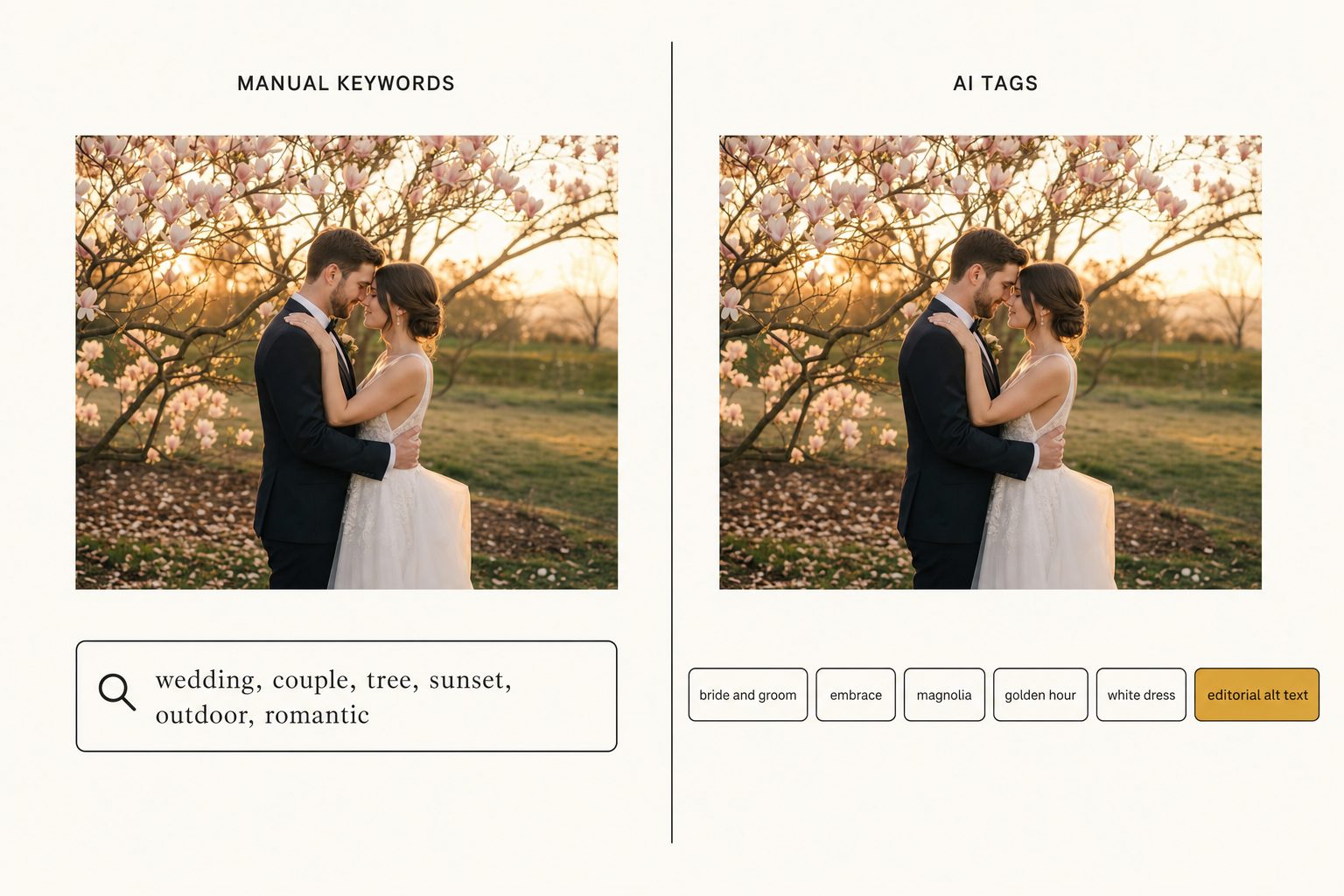
A human keyworder tagging 10,000 photos over two weeks will use "twilight" Tuesday, "dusk" Friday, and "blue hour" the following Monday on photos shot at the same time of day. An AI service tags every blue-hour photo with "blue hour." Search reliability depends entirely on consistency.
The focal-subject method identifies the dominant subject of each photo, not every object visible in frame. Search ranks results by relevance instead of returning a flat list of every photo containing "rooftop." See the complete guide for the longer treatment.
The vision model generates lines like "A bride and groom embracing under a flowering magnolia tree at golden hour," the descriptive sentence the W3C accessibility guidelines ask for. A human keyworder under time pressure rarely writes anything that specific, if they write alt text at all.
Where manual still wins
An AI model has not seen your product line names, internal team shorthand, or the in-jokes attached to a particular series. If a sneaker line is named "Marble Court," the AI tags "sneaker, white leather, marble surface" and misses the product line name. A custom vocabulary upload or a human pass fixes this.
Vision models recognize "wedding" reliably, but "Jewish wedding under a chuppah with a ketubah signing in progress" is hit and miss. The model recognizes "food" but is shakier on a specific regional dish by name.
One wrong AI-generated tag visible on a customer-facing page is worse than fifty missing tags. For photos going straight to public, a quick human spot-check is cheap insurance.
The summary: AI handles the bulk of the library to a higher consistent standard than a tired human. The human handles the brand-specific and the high-trust subset. Neither approach is "better", they are good at different things.
Cost: a 75% reduction in year one, 95% by year three
AI tagging costs a fraction of manual keywording, and the gap widens every year the library grows. Here is the real money on a 10,000-photo library that adds 2,000 photos per year.
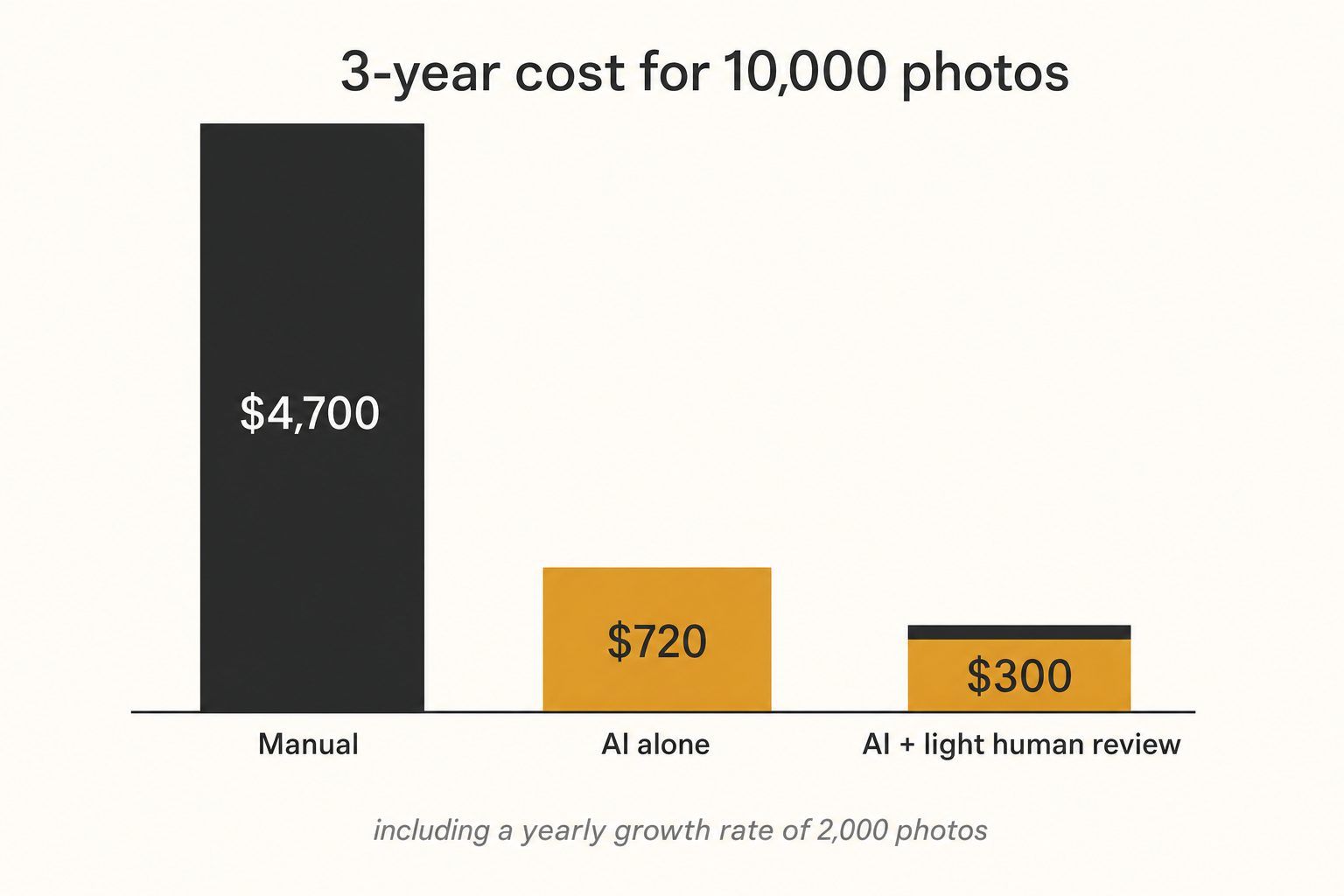
Manual. At $40 per hour freelance, 67 hours for the initial pass costs $2,680. Each yearly addition of 2,000 photos costs 13 hours, or $520. Three-year cost: $2,680 + $520 + $520 = $3,720, not counting the consistency review you should do every year to keep the existing tags coherent (add another $1,000 over three years for that). Total: about $4,700.
AI service, paid tier. Paid subscriptions for AI tagging services in this category typically range from around $10 to $30 per month for the small-team tiers (check each vendor's current pricing page for specifics). Using $20 per month as an illustration: the initial scan of 10,000 photos costs the first month's subscription, and each yearly addition rides on the same subscription. Three-year cost at that illustrative rate: $720, plus essentially zero human time. Total: $720.
Hybrid (AI bulk pass plus 5% human correction). AI scan covers all 10,000 photos for $20. A keyworder spot-corrects the 500 photos that get used heavily, at roughly 1.5 hours of work, costing $60. First year: $80. Three-year cost with growth: about $300.
The cost gap compounds the longer the library lives. By year three, the all-manual approach costs roughly 15 times what the hybrid costs and 6 times what pure AI costs, and the quality of the hybrid output is higher than either alternative.
The hybrid approach is what working teams actually use
The teams getting the best result run an AI bulk pass on everything, then put human hours only on the photos that get used. Treating this as a binary, AI replaces humans or humans hold the line on quality, is the mistake, and the best teams do neither.
The pattern that works:
Step 1. Run the AI bulk pass on the whole library. Get focal-subject labels, structured tags, and alt text on every photo at once.
Step 2. Identify the subset that needs human attention. Usually it is the photos that get used: hero shots, repeat-use brand photos, anything heading straight to a public surface. For a typical marketing library, this is 5 to 10% of the total.
Step 3. A human reviews the AI tags on that subset. Add brand-specific terms the AI could not have known. Correct any wrong tags. Add any culturally specific descriptors.
Step 4. Trust the AI tags on the remaining 90 to 95%. Those photos may never be used; tagging them is insurance for future search.
This pattern produces a library that is fully searchable in days instead of weeks, with editorial-grade tags on the photos that matter most, at roughly 1/15 the all-manual cost. It is not a compromise. It is the optimal allocation of human attention.
The deeper-dive comparison of AI bulk-tagging services is in our complete guide to AI photo tagging. The mechanics of how vision models actually generate tags are well-covered in Anthropic's vision documentation for one model family. For the standard keyword metadata format these tags eventually export to, see the IPTC Photo Metadata Standard, which is the format Lightroom, Bridge, and most asset managers read and write.
How to decide
- Pick manual keywording alone if your library is small (under 500 photos), static (not growing), and you sit on a deep well of brand-specific vocabulary that an AI could not guess. Even then, expect to spend a few hours and rebuild every time the team's vocabulary shifts.
- Pick AI tagging alone if your library is large, the photos are mostly self-explanatory subjects (events, products, real estate, food), and you do not need brand-specific terminology on every photo. Pick a service that connects directly to your storage so originals never leave the source of truth.
- Pick the hybrid approach if you have more than 500 photos, your library grows, and a meaningful subset of photos heads to public surfaces where one wrong tag would matter. This is most teams. Run AI on everything; spot-correct the high-use subset.
Try the AI bulk pass on your own library
If you want to see what a focal-subject AI tagging output looks like on your own photos before evaluating any of the above, Tagrly's free tier tags the first 500 photos in any Google Drive or Dropbox folder for free, no credit card. Point it at a sample of 50 to 100 representative photos and you will have the full output (focal subject, structured tags, alt text, searchable index) from a scan that runs unattended in the background. That is enough output to compare against a sheet of manual keywords on the same photos and judge for yourself.
When you are ready, run the free bulk pass on your own folder and compare the output side by side with a sheet of manual keywords on the same shots.
For the sibling guides on running this against specific storage providers, see bulk-tagging photos in Google Drive and bulk-tagging photos in Dropbox. For the alt-text-specific deep dive, see auto-generating alt text for thousands of images.
Frequently asked questions
How much faster is AI photo tagging than manual keywording?
Roughly 50 to 100 times faster, depending on library size. A skilled human keyworder produces 100 to 200 photos per hour at editorial depth. A modern AI tagging service runs the scan unattended in the background, so it costs no human attention at all. On a 10,000-photo library, manual keywording is a one-to-two-week project; an AI scan is one unattended pass.
Is AI photo tagging quality good enough to replace human keywording?
For most teams: yes for the bulk of the library, with spot-correction on the part that matters. AI tagging beats human keywording on consistency, focal-subject ranking, and alt-text generation. It still loses on brand-specific vocabulary (product line names, internal codes, your team's shorthand) and on rare or culturally specific subjects. Most teams do not need pure AI or pure manual; they need an AI bulk pass followed by light human correction on the photos that get used in marketing.
What does manual keywording still do better than AI?
Three things. (1) Brand-specific vocabulary the model could never guess: product line names, internal team shorthand, client names. (2) Cultural and contextual subtlety: knowing 'the look' your brand uses, the era a vintage piece belongs to, the in-joke a photo references. (3) Trust on photos that will be public-facing immediately, where one wrong tag visible to a customer is worse than a hundred missing tags.
How much does it cost to tag 10,000 photos with AI versus manually?
Manual keywording at a $40-per-hour freelance rate runs about $2,680 for one-time keywording of 10,000 photos (67 hours at 150 photos per hour). An AI tagging service runs $10 to $30 per month subscription, so the first month covers 10,000 photos and you can re-scan or extend without paying again. After the first year the gap is roughly $2,680 versus $360. For a library that grows, the gap widens every month.
Can I combine AI and manual keywording?
Yes, and most teams using both AI and human review end up here. The standard pattern is an AI bulk pass on the whole library, then a human pass on the subset that gets used: hero shots, repeat-use brand photos, anything tagged as low-confidence by the AI. The AI handles 95% of the library at zero marginal time; the human handles the 5% that matters.
Do AI tags work for niche or brand-specific vocabulary?
Partially. Modern vision models recognize most common objects, settings, materials, and styles. They do not know your product line names, your internal team shorthand, or the name of the photographer who shot a series. The fix is either to add a custom-vocabulary layer (some services support this) or to do a light human correction pass on the photos that need brand-specific tags.
Try Tagrly on your own photo library
Connect your Google Drive or Dropbox folder and Tagrly will tag every photo in bulk. Search by what is actually in the image, share specific shots with clients, and never lose a photo again.
- Free for your first 500 photos
- Read-only access, revoke anytime
- No credit card