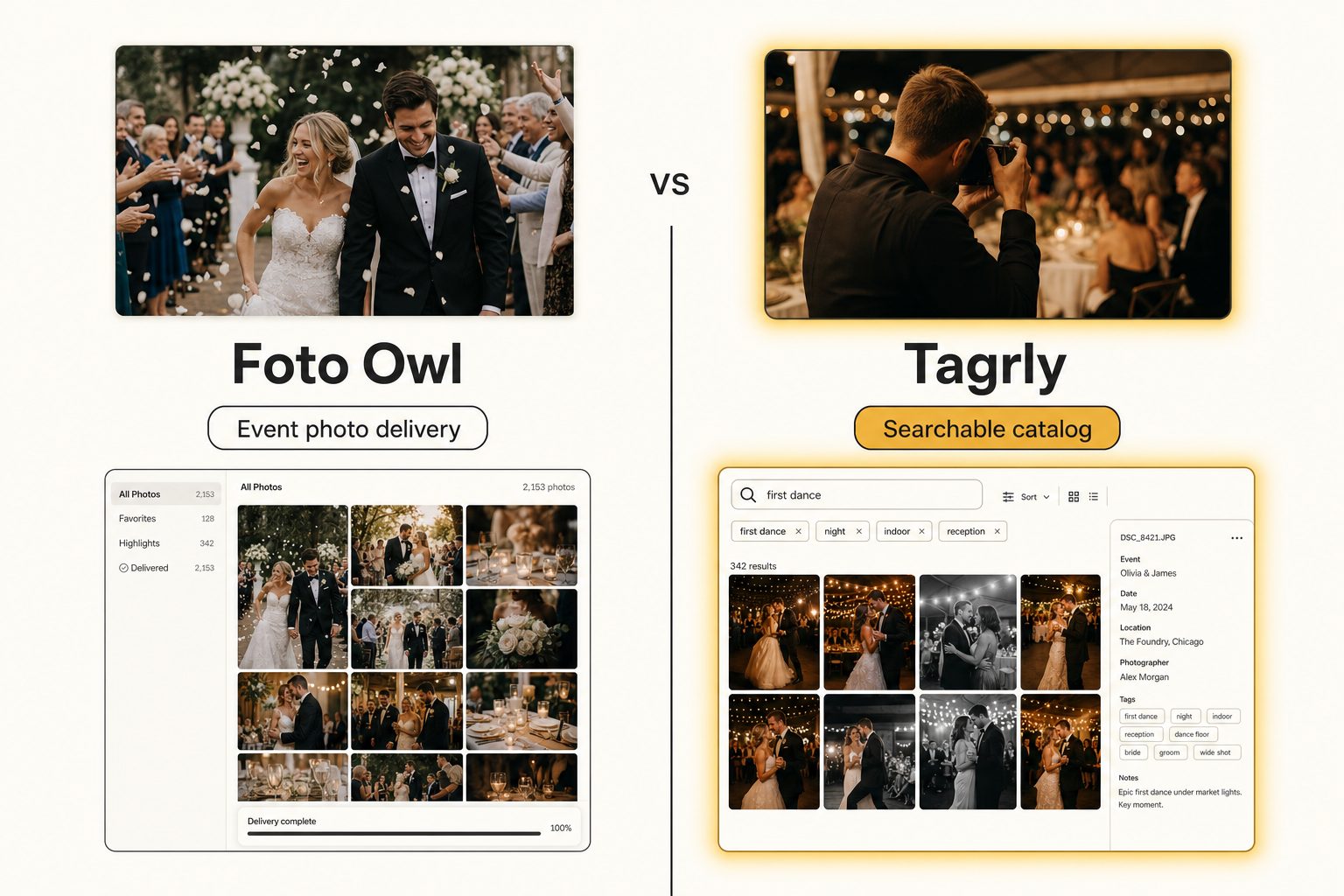
You shot a 600-guest gala on Saturday, the photos are sitting in a Foto Owl gallery, and attendees are already getting WhatsApp links to the shots they appear in. That part works.
Then on Monday the marketing director asks for "the four rooftop shots with the blue step-and-repeat" from across the last three years of events, and there is no way to ask a face-recognition tool a question like that. This is the post for that moment, when you are looking at Foto Owl alternatives and trying to work out whether you need a different event-delivery tool or a different kind of tool entirely.
What Foto Owl actually is
Foto Owl is a photo-delivery platform built around the event. You shoot an event, upload the photos, and its AI groups them by the people who appear in each frame, builds a personalized gallery for every guest, and notifies attendees so they can find and download their own pictures without scrolling through thousands of shots. The Foto Owl AI gallery page makes the audience clear: photographers and event organizers running high-volume shoots who need photos in attendees' hands fast.
The intelligence under the hood is face recognition, and it is the good kind. Foto Owl matches faces accurately across poses, sunglasses, and accessories, which is exactly what an outdoor festival or an awards night needs.
On top of that it layers automated delivery (email and WhatsApp notifications when a gallery is ready), custom branding so every shared photo promotes the photographer or the sponsor, and a photo-selling feature for monetizing prints and downloads. It supports weddings, sports, corporate events, and festivals.
That event focus is the point. A photographer who needs to turn a wedding or a 5,000-guest conference into per-attendee galleries gets exactly that, fast, the same day. Foto Owl does that one job well and does not pretend to be a general photo-organization tool.
Note. "Gallery," "delivery," and "catalog" sound similar but name different jobs. A gallery is what one client or one event's attendees see, scoped to that shoot. A catalog is the searchable index a team keeps behind the scenes across every shoot. Foto Owl is squarely a gallery-and-delivery tool built around faces. A catalog is built around finding any photo by what it shows. The word tells you the audience: "guest gallery" and "face match" lean event-delivery, "library" and "search" lean team catalog.
What Foto Owl costs
Foto Owl prices as an event-photography tool, with tiers scaled by photo volume and features rather than as a flat per-seat library subscription. As of September 2026 its plan list starts with a free Rider tier, and paid plans begin around $16 a month billed yearly, so there is a low-friction way to try the face-recognition delivery before paying.
Exact figures move around and depend on how many events and how many photos you process, so check Foto Owl's current pricing rather than trusting a number that may be stale by the time you read this. Either way, the shape of the cost is "pay for the volume of photos you run face recognition on," which makes sense for a tool whose value is per-event delivery.
The math is genuinely in Foto Owl's favor for its job. If your work is delivering events to attendees, you want cost that scales with event volume, and that is what it sells. The cost question only changes shape when the job stops being delivery and becomes search, because then you are no longer paying to route photos to the people in them, you are paying for a team to find any photo across a whole archive, and a per-event delivery tool does not sell that.
Why people look for Foto Owl alternatives
Most photographers who use Foto Owl are happy with the face-recognition delivery. The reasons they go looking for an alternative cluster into three, and none of them is "the face matching is bad."
- The job is search, not delivery. The photos are not for one event's attendees, they are a years-deep archive in Google Drive or Dropbox, and the team needs to find a specific shot by scene or subject. Face recognition does not answer "find the rooftop sunset shots."
- A whole team needs the library, not just guests. Foto Owl is built around the attendee finding their own photos. When the people who need the library are coworkers searching one shared surface every week, the event-gallery shape stops fitting.
- The output goes on a website. A delivered gallery is for downloading, not for publishing. When the photos end up on a blog or a press page, you need descriptive alt text per photo, which a delivery tool does not generate.
If none of those describe you, Foto Owl is probably still the right tool and you can stop reading. If one or more do, the useful question is not "which event-delivery tool is better than Foto Owl," it is "do I need an event-delivery tool at all, or a searchable catalog."
Three kinds of Foto Owl alternatives
The alternatives split into three groups, and the right pick depends on which of the three reasons above sent you looking.
Other face-recognition event-delivery tools
If your job has not changed and you just want a different event-delivery platform, you stay in Foto Owl's own tier. Tools like Kwikpic, Pixieset, and Pic-Time live here: they take an event's photos, group or gallery them, and deliver them to clients and attendees, some with their own face-recognition matching. This is a lateral move, swapping one event tool for another, and it is the right move when the job is still "get this event's photos to the people in them."
Proofing and client-gallery platforms
If you mostly need a branded space to deliver a finished set to one client and collect their picks, the proofing-gallery tools (Pixieset, Pic-Time, ShootProof) overlap with Foto Owl on delivery without leaning as hard on attendee-by-face self-serve. They are built for the photographer-to-client handoff rather than the festival-crowd-to-attendee handoff. We cover where dedicated proofing galleries fit in our guide to sharing specific photos with clients.
Searchable catalogs
If the photos live in Drive or Dropbox and a team searches them repeatedly by what is in each shot, the better-shaped alternative is a catalog that reads your storage and builds one searchable surface. Tagrly sits here. Instead of grouping one event's photos by face, it connects read-only to the cloud folder you already have, tags everything in bulk with scene and subject descriptions, and lets the whole team search one place. This is not a lateral move from Foto Owl, it is a change of category, and it is the right one when the job has shifted from "deliver this event" to "let the team find any photo on a Thursday."
Where Tagrly fits as a Foto Owl alternative
Tagrly answers a different question than Foto Owl, and that difference is the reason to consider it.
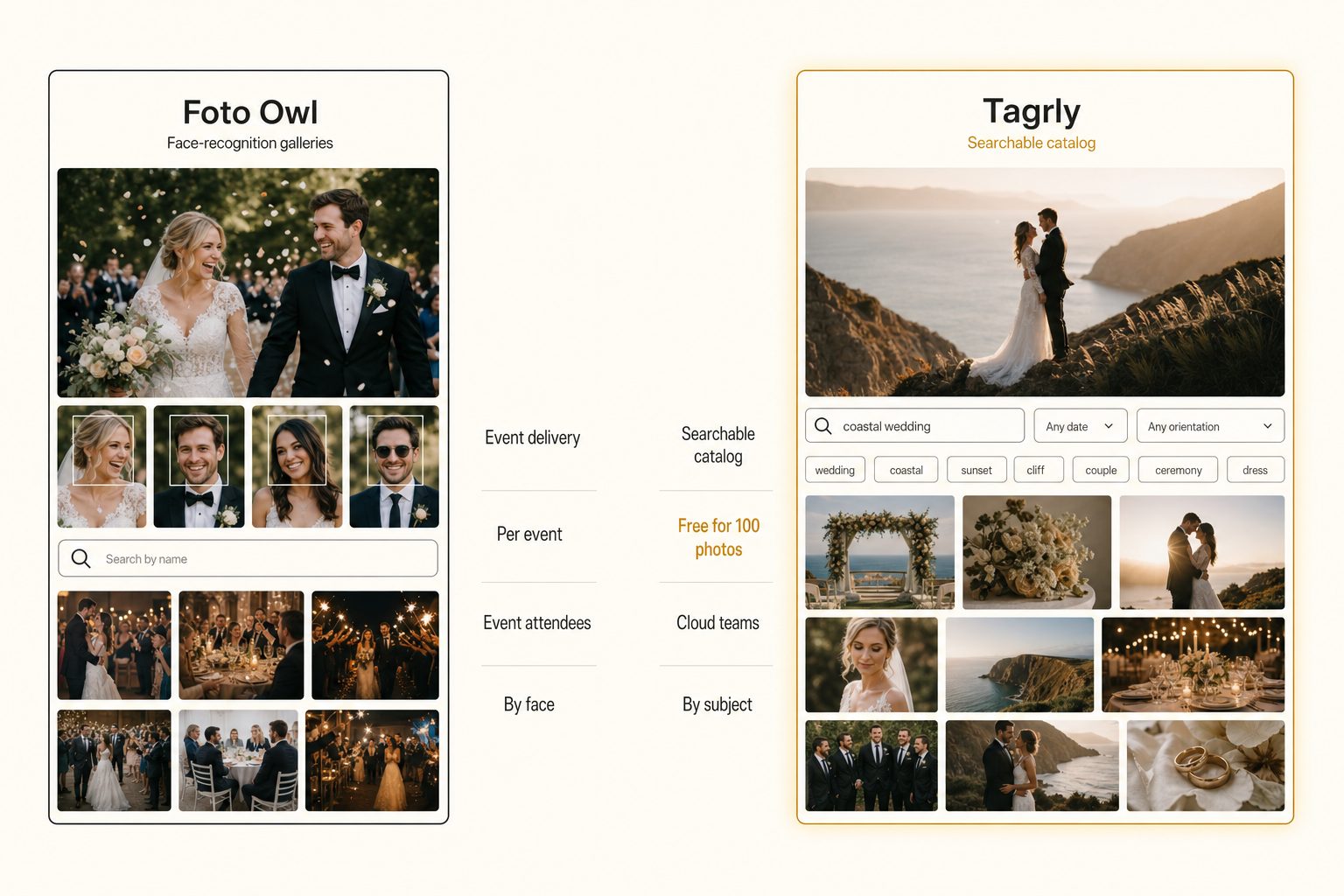
Instead of grouping one event's photos by the faces in them, Tagrly connects read-only to the Google Drive or Dropbox you already use, walks the folders you pick, sends each photo through a vision model, and writes the results to a searchable catalog. Your originals never move, nothing is installed, and the team searches one shared surface in a browser. The Drive connection uses the drive.readonly scope, so the tool can read your photos but never change or delete them.
Two things it does that an event-delivery tool does not. First, focal-subject tagging: every photo gets one dominant-subject label ranked above its background context, so a search for "rooftop sunset" surfaces photos that are about a rooftop sunset, not every photo that happens to contain a sky. Second, an editorial-grade alt text tier that writes a full publishable sentence per photo instead of routing it to a guest, which matters when the photos end up on a website rather than in an attendee's download. We define both frameworks in the complete guide to AI photo tagging, the named methods Tagrly recommends across the category.
In Tagrly's own testing on a 5,000-photo set, focal-subject tagging returned the right photo as the correct top search result in roughly 9 of 10 queries. The first scan left a fully searchable catalog, with focal-subject labels and alt text on every photo, with nobody typing keywords by hand.
The difference from an event-delivery tool is not the photos, both handle real shoots. It is the question you can ask afterward. With Foto Owl you finish with each guest holding their own gallery. With a catalog you finish with a surface the whole team types a query into and gets the right shot back, across every event you ever shot.
Tip. Want to judge the tagging on your own photos instead of a marketing screenshot? Tagrly's free tier tags the first 500 photos in any Drive or Dropbox folder, no credit card. Connect a sample folder and read the tags it writes back before you commit to anything.
The limits matter too. Tagrly is not an event-delivery tool. It does not run face recognition to match guests to their photos, it does not build per-attendee galleries, and it does not push WhatsApp notifications to a crowd.
If your whole job is "deliver this event to the people who were in it," Foto Owl is the better fit and a catalog would not solve the problem you actually have. Tagrly earns its keep when the library is shared, growing, mixed across many shoots, and searched by content rather than by face.
Tagrly vs. Foto Owl, side by side
The two tools are not really competing on the same axis. They are two answers to "what do I need to do with a pile of event photos."
| Foto Owl | Tagrly | |
|---|---|---|
| Shape | Face-recognition event delivery | Searchable catalog |
| Core intelligence | Face matching (who is in the photo) | Content tagging (what is in the photo) |
| Connects to Drive / Dropbox | Upload per event | Yes (read-only, in place) |
| Primary user | Event attendees and clients | A team |
| Search by scene or subject | No | Yes (focal-subject tagging) |
| Editorial alt text for publishing | No | Yes (every photo) |
| Automated guest delivery (email / WhatsApp) | Yes | No |
| Pricing model | Scaled by event photo volume | Monthly subscription + free first 500 photos |
| Best audience | Event and wedding photographers delivering to attendees | Teams searching a mixed cloud library |
A few things worth saying plainly. Foto Owl matches faces and delivers per-attendee galleries automatically, which Tagrly does not do at all, and that is a real point in its favor if your job is event delivery. On the other side, Foto Owl does not turn a mixed Drive into a surface a team can search by scene or subject, and it does not write alt text for public pages, which is the entire reason a searchable catalog exists. Neither is "better," they are shaped for different jobs. For the privacy side of the tradeoff, face recognition carries its own consent and data obligations under rules like the GDPR's treatment of biometric data; a content catalog that tags scenes and objects sidesteps that entirely because it never builds a face database.
Warning. Watch the word "find." Foto Owl helps a guest find themselves in a crowd of photos, which is a face problem. A catalog helps a team find a subject across a crowd of shoots, which is a content problem. Both are legitimate, but they are not the same search. If the question you keep asking is "where is the photo of the X," not "where are the photos of person Y," a face-recognition tool will keep coming up short no matter how good its matching is.
How to choose: pick X if Y
Skip the feature checklist and answer one question: do you need to deliver one event's photos to the people who were in them, or find any photo across a growing library a team shares?
- Pick Foto Owl if you shoot weddings, sports, festivals, or corporate events at volume, you want each attendee to find and download their own photos by face, and you want that delivery automated over email and WhatsApp the same day. For per-event, per-attendee delivery it is the right shape and a catalog would not solve it.
- Pick a proofing gallery like Pixieset or Pic-Time if you mostly hand a finished set to one client and collect their selects, rather than routing a crowd to themselves by face.
- Pick Kwikpic or a similar event tool if you want the same face-recognition delivery Foto Owl offers but a different engine, price, or feel. That is a lateral swap inside the event-delivery tier, not a category change.
- Pick Tagrly if your photos live in Google Drive or Dropbox, a team needs to search them by what is in each shot, the archive keeps growing across many shoots, and you want editorial-grade alt text for public pages. The free first-500-photo tier lets you check the output before committing; see how the plans compare once you have a sense of your library size.
If you are torn specifically between Foto Owl and Tagrly, the deciding question is almost never which AI is smarter. It is what you do with the photos next. Routing one event to its attendees is a delivery job, and Foto Owl owns it. Finding any photo across a years-deep shared archive is a search job, and that is a catalog. Many busy studios run both: Foto Owl to deliver the shoot to the people in it, and a catalog behind the scenes so the team can find anything later.
For the wider category, see the complete guide to AI photo tagging, our Tagrly vs. PhotoTag.ai comparison if you are weighing the upload-and-export keyword tools, and our Tagrly vs. ON1 Photo Keyword AI comparison if a desktop keyworder is also on your list. The short version: the best Foto Owl alternative is the one shaped for what your photos do next, and for a team that needs to search a mixed cloud library that turns out to be a catalog rather than another event-delivery tool.
Frequently asked questions
What is the best alternative to Foto Owl?
It depends on what is pushing you off Foto Owl. If you still want face-recognition event galleries that match each guest to their photos and deliver them automatically, the closest alternatives are other event-delivery tools like Kwikpic, Pixieset, or Pic-Time, and you stay in that event-photography tier. If the real problem is that you have a large mixed library in Google Drive or Dropbox that a team needs to search by what is in each photo, that is a different job and a different category. Tagrly is one example of the searchable-catalog approach, priced as a monthly subscription with a free first-500-photo tier. Match the alternative to the task: delivering one event's photos to attendees keeps you on an event tool, finding any photo across a growing shared library moves you to a catalog.
What is the main difference between Tagrly and Foto Owl?
Who they serve and what they do with a photo. Foto Owl is an event-photography delivery platform. It runs face recognition on the photos from a single event, matches each guest to the shots they appear in, builds a personalized gallery, and pushes it out by email and WhatsApp so attendees can find and download their own pictures. The product is built around the event and the attendee. Tagrly is a searchable catalog for a team. It connects read-only to the Google Drive or Dropbox you already use, tags every photo in bulk with AI descriptions and editorial alt text, and gives a team one shared surface to search and pull any shot from. Foto Owl answers 'get this event's photos to the people in them.' Tagrly answers 'let our team find any photo in a 20,000-image archive.'
Does Foto Owl connect to Google Drive or Dropbox to tag a whole library?
Not in the way a catalog does. Foto Owl is built around uploading the photos from a specific event into a Foto Owl gallery, where its face-recognition engine groups them by the people who appear in them and delivers them to attendees. It is not designed to walk a years-deep Google Drive or Dropbox folder of mixed shoots and build one searchable index you can query by scene, object, or focal subject. If your photos already live in cloud storage and the job is team-wide search rather than per-event delivery, a connected catalog like Tagrly is the better-shaped tool, because it reads your existing folders in place and tags everything for search.
How much does Foto Owl cost?
Foto Owl publishes tiered plans for event photographers. As of September 2026 there is a free Rider tier, and paid plans start around $16 a month billed yearly, with higher tiers adding more photo volume and features. The exact numbers move around, so check Foto Owl's current pricing page before you budget rather than trusting a figure that may be stale by the time you read this. The short summary: it is priced as an event-photography tool, where cost scales with the volume of photos you run face recognition on, not as a flat per-seat library subscription.
Can Foto Owl search a photo by what is in it, like 'rooftop sunset'?
That is not what it is built for. Foto Owl's intelligence is face recognition: it is very good at finding every photo a specific person appears in and routing those photos to that person. It is not a scene-and-object search engine for a general library, so a query like 'rooftop sunset' or 'the three shots of the blue dress' is outside its core job. A searchable catalog is built for exactly that kind of content query. Tagrly tags each photo with a focal subject, context tags, and a descriptive sentence, so the library can be searched by what a photo shows rather than by who is in it.
When is Foto Owl the right choice over a catalog like Tagrly?
When your job is delivering one event's photos to the people who were there. Pick Foto Owl if you shoot weddings, sports, festivals, or corporate events at high volume, you want each attendee to find and download their own photos by face, and you want that delivery automated over email and WhatsApp the same day. A searchable catalog cannot do attendee-by-face self-serve delivery, and Foto Owl does it well. You only outgrow Foto Owl when the problem stops being 'deliver this event' and becomes 'our team needs to find any photo across a large, mixed, always-growing archive,' which is a catalog's job, not a delivery tool's.
Try Tagrly on your own photo library
Connect your Google Drive or Dropbox folder and Tagrly will tag every photo in bulk. Search by what is actually in the image, share specific shots with clients, and never lose a photo again.
- Free for your first 500 photos
- Read-only access, revoke anytime
- No credit card