
Three of you run marketing for a growing brand. The product photos are on the designer's laptop, the event shots are in the founder's Dropbox, and the latest shoot is still on the photographer's hard drive. Someone needs the top-down product photo on marble for an ad going live tomorrow, and nobody is sure who has it. A shared photo library is the fix: one home everyone on the team can reach, search, and reuse.
What a shared photo library actually is
A shared photo library is not a folder you happened to send a link to. It is one home for the team's photos with three traits that a personal folder lacks.
- Team-owned. It is owned by the team, so when someone leaves, the photos do not leave with them.
- Single source of truth. There is one place to look instead of five.
- Searchable. Ideally it is searchable by what a photo shows, so finding a shot does not depend on one person remembering where it lives.
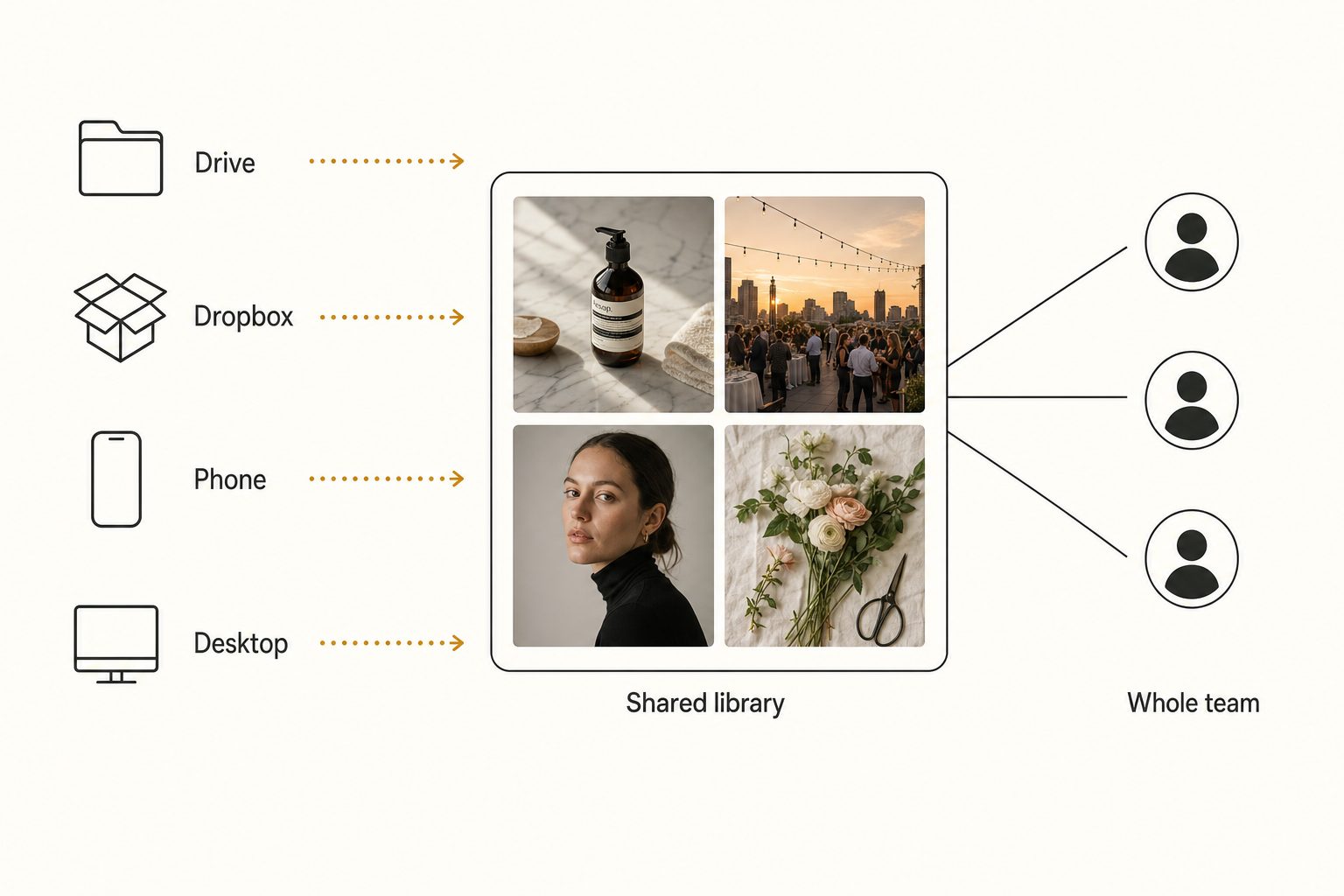
The hardest part is usually the first trait. No amount of clever organization helps until everything lives in one team-owned home, so pick that home and move everything into it before you do anything else.
Step 1: pick one home the team owns
The first decision is where the library lives, and the rule is simple. It must belong to the team, not to a person.
In Google Workspace, that means a shared drive, not a folder in someone's My Drive. A shared drive is owned by the team, so files stay put when an employee leaves. A Dropbox team folder works the same way. Pick whichever your team already uses.
Avoid building a work library on a personal Google Photos account. Google Photos shared albums are genuinely good at content search and faces, but it is a consumer product tied to individual accounts, which is the wrong foundation for a library the business needs to own.
Warning. If your photos currently live on one person's laptop, that laptop is your single point of failure. A spilled coffee or a resignation takes the whole library with it. Moving everything into a team-owned shared drive is the most important step here, and the one teams most often skip.
Step 2: agree on structure and naming
Once the photos are in one home, a little structure keeps the library usable as it grows. Two habits do most of the work.
A simple folder structure: top level by year, then by project, campaign, or shoot, with a selects subfolder for approved shots so people are not digging through 400 raw frames to find the 8 that matter.
A naming convention every file follows. A name like 2026-03_product-launch_hero_01.jpg tells you the date, project, role, and sequence at a glance, and it makes a shared drive's plain filename search actually work, unlike IMG_3382.JPG.
Note. Naming and folders hold up well under about 1,000 photos. Past that you hit what we call the 1,000-photo wall, described in the complete guide to bulk image tagging: the library gets too big to remember and too big to rename by hand. That is the point where most teams start looking at a tool.
Step 3: set access so the right people get in
A shared library is only shared if the right people can reach it, so set access deliberately rather than emailing links one by one.
On a shared drive, grant membership at the drive level so new photos are automatically visible to everyone who should see them. Use viewer access for people who only find and download, and editor access for the few who organize and upload. Keep the editor list short; most of a team only needs to find photos, not rearrange them.
Audit who has access twice a year. Permission sprawl is real on small teams too: the freelancer added in 2024 probably still has access to everything. For the broader system this fits into, including intake and archiving, see our photo workflow for marketing teams.
Step 4: make it searchable past 1,000 photos
The free setup above carries a small team a long way. The stage it stops covering is search, and it stops right around the point the library gets big enough to be worth having.
Folder and filename search only works if every file was named perfectly, which rarely survives a busy quarter. Once a shared library passes a few thousand photos, "where is that product shot" turns into a slow scroll or a Slack message to whoever filed it. Disorganized libraries also cost real time: a 2021 Canto survey of 500 marketing professionals found that about a third spend roughly three weeks a year just looking for files.

An AI photo catalog closes that gap. It connects to your shared Drive or Dropbox with read-only access, streams each photo to a vision model, and stores a sentence and tags describing every shot. Your originals never move.
From then on anyone on the team types a plain description, "product on marble, top down" or "candid team laughing at the launch," and the matches come back in milliseconds, ranked by the focal-subject tagging method, so a photo of your subject outranks a photo that merely contains it. In Tagrly's own testing on a 5,000-photo set, focal-subject tagging surfaced the correct top match in roughly 9 of 10 searches, the hit rate that makes AI photo search worth running over a shared folder. We cover this in detail in how to search photos by description in Google Drive.
Tagrly is one tool here, and not the only one that connects directly to a shared drive. Foto Owl and Pics.io do too. What separates them is output quality, so judge a tool on the tags it produces.
A full scan runs unattended in the background. After that, anyone on the team finds a photo by description faster than the person who filed it can remember which folder it went in.
Tip. Want to see this on your team's own photos? Tagrly's free tier tags the first 500 photos in any Drive or Dropbox folder at no cost, no credit card. Connect a real folder and search the results before you commit to anything.
Step 5: share specific photos, not the whole library
A shared library inside the team is one thing. Sending photos to a client or freelancer is another, and it is where folder-based setups leak.
When someone outside the team needs four photos, the lazy move is to share the entire project folder, which exposes unapproved shots, raw frames, and sometimes another client's work. A better approach shares a collection: select the approved photos, group them, and send a single link so the recipient sees only those shots and never touches the rest of the library.
Most image catalogs build per-collection sharing in, often with an expiry date on the link. Confirm a tool supports it before you commit, because a team reaches for it every week.
Which setup fits your team
There is no single right answer, only the right one for your team size and photo count.
- A team under about 1,000 photos. A shared drive, a strict naming convention, and folder-level access. Free and genuinely enough. Do not pay for a tool yet.
- A 2 to 10 person team with a few thousand photos. Keep the shared drive for storage, add an AI photo catalog (Tagrly is one example) so search and client sharing stop eating your week.
- A team that mostly shares photos outward. Prioritize per-collection sharing and access control over raw tagging speed; that is the feature you reach for daily.
- A larger team with a procurement budget. An enterprise photo platform with approval flows and brand governance may justify its price. For teams under 25 people it is usually overkill.
A shared photo library for a small team comes down to one rule: one team-owned home that everyone can search. Folders, naming, and a shared drive carry you well past your first few projects, and there is no reason to pay for a tool before the 1,000-photo wall. Past it, an AI catalog that reads each image and shares clean collections turns a scattered set of folders into something the whole team can use.
The fastest way to know if that is your team is to run it on a real folder of your photos and search the results. For the bigger picture, see our guide to finding any photo in your library.
Frequently asked questions
What is a shared photo library?
A shared photo library is one home for a team's photos that everyone can reach, search, and reuse, instead of photos living on one person's laptop or scattered across five inboxes. The basic version is a shared drive in Google Workspace or Dropbox that the team owns rather than an individual. A stronger version adds search by what a photo shows and a way to share specific shots without handing over the whole folder. The defining trait is ownership by the team: when someone leaves, the photos stay. The point is that no single person becomes the bottleneck for finding or accessing the team's images.
How do I set up a shared photo library for a small team?
Start by picking one home and moving every photo into it, ideally a shared drive in Google Workspace or a Dropbox team folder so the library belongs to the team, not a person. Agree on a folder structure (top level by year, then by project or shoot, with a selects subfolder for approved shots) and a naming convention every file follows. Set access at the folder level so the right people can view or edit. This is enough under about 1,000 photos. Past that, add a tool that tags and searches the library so people find photos by describing them instead of remembering where they are filed.
Should a small team use Google Drive, Dropbox, or Google Photos for a shared library?
For a work library, use a shared drive in Google Workspace or a Dropbox team folder, because both belong to the team and survive turnover. Google Photos shared albums are excellent for content-based search and faces, but it is a consumer product tied to personal accounts, so it is a poor fit for a library the business needs to own and control. Pick Drive if your team already lives in Google Workspace, and Dropbox if your files are already there. The storage choice matters less than the rule that the library is owned by the team and everything lives in one place.
How does a small team find a specific photo in a shared library?
Search by what the photo shows, not by its filename. Folder and filename search only works if every file was named well, which rarely survives a busy quarter. An AI photo catalog reads each image, writes a sentence and tags describing the scene, and stores them in a searchable index. Anyone on the team then types a plain description like 'product on marble, top down' and the matching shots come back in milliseconds, ranked so the closest match is first. For a few thousand shared photos this is far faster than scrolling or relying on one person's memory of the folder tree.
When should a small team move beyond a shared drive?
Around the 1,000-photo mark. Below that, a shared drive, a strict naming convention, and the built-in filters are genuinely enough, and you should not pay for a tool yet. Above it you hit the 1,000-photo wall: the library gets too big to remember and too big to rename by hand. That is the point where the hours your team spends hunting for shots, and re-shooting ones it cannot find, cost more than a tool would. The way to know is to run a catalog over a real folder and see whether search saves the time you expect.
Try Tagrly on your own photo library
Connect your Google Drive or Dropbox folder and Tagrly will tag every photo in bulk. Search by what is actually in the image, share specific shots with clients, and never lose a photo again.
- Free for your first 500 photos
- Read-only access, revoke anytime
- No credit card