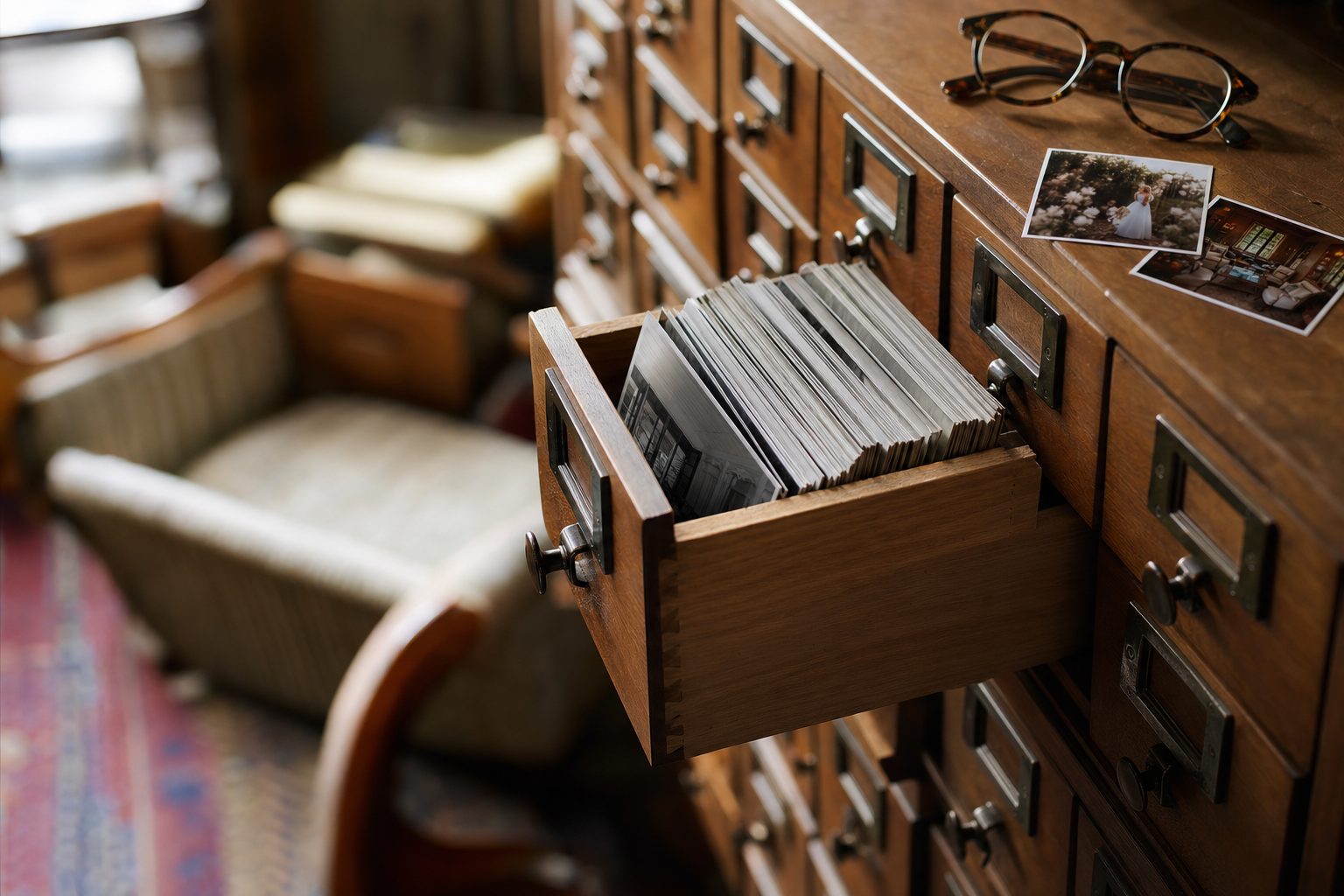
It is Tuesday, the fall menu launches Thursday, and your social manager needs the overhead shot of the new short-rib plate plus a warm photo of the patio at golden hour. The plating shot is on the chef's phone, the patio shot is buried in last year's Drive folder, and August's professional shoot still sits in the photographer's Dropbox. A restaurant photo archive is the fix: one place the venue owns where every food, interior, and event photo lives and stays findable.
What lives in a restaurant photo archive
A restaurant photo archive holds five kinds of photos, and they scatter because they come from different cameras and different people. A working venue generates all five, rarely from the same shoot.
- Food and menu. Plated dishes, ingredients, seasonal specials. The most-used and most-reshot category.
- Interiors and ambiance. The dining room, the bar, the patio, the private room, lit for day and for evening.
- Events and private dining. Buyouts, tastings, holiday parties, the photos a sales team sends prospects.
- Team and behind-the-scenes. The chef, the line, the bartender mid-pour, the human content social audiences love.
- Seasonal and promotional. Holiday menus, limited specials, and the steady trickle from staff phones.
Those photos feed the channels that bring people in: your website, Instagram, the food photos on delivery apps, and your Google Business Profile. Google's own Business Profile photo guidance asks for at least three interior, three exterior, three food or drink, and three team photos, kept current, so the archive is not decoration. The catch is spread: five buckets and several contributors scatter thousands of images across a dozen places nobody else can reach.
One boundary before the steps. If the restaurant is one outlet of a hotel or resort, the property-wide library is its own discipline, covered in our hospitality photo library guide. This guide owns the standalone restaurant.
Step 1: give the archive one home the venue owns
The archive must belong to the restaurant, not to a person, so the first decision is which venue-owned storage it lives in.
In Google Workspace that means a shared drive, not a folder in the marketing manager's My Drive. A shared drive is owned by the team, so files stay put when someone leaves. A Dropbox team folder works the same way.
Hospitality runs on high turnover, so this matters more here than almost anywhere: the GM who has every photo on a personal phone is a resignation away from taking the archive with them.
Pull the photographer's delivered shoots, the chef's plating shots, and the event photos into that one home before anything else. No amount of clever structure helps until everything lives in a single place the venue controls. If you are setting this up for a small marketing crew, our guide to building a shared photo library covers access and ownership in more detail.
Warning. If your best food photos live on the chef's or the owner's personal phone, that phone is your single point of failure. A cracked screen or a resignation takes years of plating shots with it, and moving everything into a venue-owned shared drive is the step teams skip most and regret most.
Step 2: structure the archive around your menu calendar
Structure the archive around the restaurant's calendar, because that is the filing system the team already thinks in. A little structure now keeps the photos usable as the archive grows.
A simple folder tree works well:
- Year at the top. One folder per year keeps this season's photos apart from the back catalog without anyone re-filing.
- One folder per bucket. Food and menu, interiors, events, team, seasonal. Group food by menu or season so the fall shoot lands in one obvious place.
- A
selectssubfolder inside the food folders. Nobody digs through 300 raw plating frames to find the 6 that are sharp.
Pair that with a naming convention every file follows. A name like 2026-09_fall-menu_short-rib_top-down.jpg tells you the season, the dish, and the angle at a glance, and it makes a shared drive's plain filename search actually return something, unlike IMG_3382.JPG.
Note. Folders and naming hold up well under about 1,000 photos. Past that you hit what we call the 1,000-photo wall, described in the complete guide to bulk image tagging: the library gets too big to remember and too big to rename by hand. A busy venue clears that wall inside a year or two of menu changes and events.
Step 3: make the restaurant photo archive searchable
Past about 1,000 photos, a restaurant photo archive needs a search layer that reads the photos themselves. Folders and filenames stop finding things right when the library gets big enough to matter.
Folder and filename search only works if every file was named perfectly, which never survives a busy service. A 2021 Canto survey of 500 marketing professionals found that about a third spend roughly three weeks a year just looking for files. In a restaurant, that is the scramble before every seasonal launch.
An AI photo catalog closes that gap. It connects to your shared Drive or Dropbox with read-only access, streams each photo to a vision model, and writes a sentence and tags describing every shot. Your originals never move.
Anyone on the team then types a plain description, "fall plating, top down" or "private dining room set for twelve," and the matches come back in milliseconds, ranked by the focal-subject tagging method so the strongest shot is first. In Tagrly's own testing on a 5,000-photo set, focal-subject tagging surfaced the correct top match in roughly 9 of 10 searches, which is what makes AI photo search usable on deadline. We go deeper in how to search photos by description.
A full scan runs unattended in the background, and what is already read is searchable while the rest is still going. Day to day, finding a dish shot by description is faster than asking whoever ran the shoot which folder it went in.
Tagrly is one tool that does this, and not the only one that connects to a shared drive; Foto Owl and Pics.io do too. What separates them is tag quality, so judge a tool on the words it produces for your photos before paying for a plan.
Tip. Tagrly's free tier tags the first 500 photos in any Drive or Dropbox folder at no cost, no credit card. Connect your fall menu shoot and search the results before you commit to anything.
Step 4: share specific shots with press and apps
Share a collection of approved shots, never a whole folder, because folder shares are where a restaurant's archive leaks.
A press contact wants three hero shots, not your raw frames; a delivery app wants clean, current food photos. Share the entire menu folder to send four images and you expose blurry rejects, last season's plating, and sometimes another location's work. A better approach shares a collection: select the approved shots and send one link that shows only those and nothing else.
This matters most for multi-location groups, where you must never send one venue's photos to another's franchisee. Per-collection links keep each outward share clean, usually with an expiry date. Our guide to sharing specific photos covers the approach, and the broader photo workflow for marketing teams shows where intake, search, and sharing fit together.
Which photo setup fits your venue
Your venue's photo count and how often you share outward pick the setup.
- A single location under 1,000 photos. A venue-owned shared drive, a strict naming convention, and folder-level access. Free and genuinely enough. Do not pay for a tool yet.
- A busy single location with a few thousand photos. Keep the shared drive for storage and add an AI photo catalog so search and outward sharing stop eating your week before every launch.
- A multi-location group, brand, or agency managing several venues. Prioritize a central searchable archive with per-location collections, so the team finds any shot and never crosses one venue's photos with another's.
- A large enterprise group with a procurement budget. An enterprise photo platform with approval flows and brand governance may justify its price. For groups under 25 marketing seats it is usually overkill.
Restaurant photo organization comes down to one rule: one venue-owned home the whole team can search. Folders, naming, and a shared drive carry a single location well past its first few menu cycles, and there is no reason to pay for a tool before the 1,000-photo wall. Past it, a catalog that reads every dish and shares clean collections turns a scatter of phones and drives into something the team can use on deadline.
The fastest way to know if that fits your venue is to run it on a real folder of your photos and search the results. Tagrly's page for restaurants shows what the team sees, and our guide to finding any photo in your library gives the bigger picture.
Frequently asked questions
How do you organize a restaurant's photos?
Start by moving every photo into one home the venue owns, a shared drive in Google Workspace or a Dropbox team folder, instead of leaving them on the chef's phone and the agency's account. Agree on a folder structure that matches how a restaurant actually works: top level by year, then by food and menu, interiors and ambiance, events and private dining, and team. Add a naming convention every file follows so a plain filename search still finds something. That setup carries a single location to roughly 1,000 photos. Past that, add a photo catalog that reads each image so anyone can search by what a shot shows rather than remembering which folder it landed in.
Where should a restaurant store its photos?
In a shared drive that belongs to the business, not in a personal account. Use a shared drive in Google Workspace or a Dropbox team folder, because both survive staff turnover, which hospitality has plenty of. The photos a restaurant relies on for its website, delivery apps, and social posts should not live on the marketing manager's phone or a freelancer's Dropbox, because the day that person leaves, the archive leaves with them. Pick whichever platform your team already uses. The storage brand matters far less than the rule that the library is owned by the venue and everything lives in one place.
How do restaurants find a specific food photo quickly?
By searching what the photo shows instead of scrolling folders. Folder and filename search only works if every file was named perfectly, which never survives a busy service. An AI photo catalog reads each image, writes a sentence and tags describing the dish or the scene, and stores them in a searchable index. Anyone on the team then types a plain description like 'fall plating, top down' or 'patio at sunset' and the matching shots come back in milliseconds, ranked so the closest match is first. For an archive of a few thousand mixed food, interior, and event photos, that is far faster than asking whoever ran the last shoot.
How do multi-location restaurant groups manage photos?
With one central archive that keeps each location's photos separate but searchable from the same place. A group running several venues hits two problems at once: finding the right shot across thousands of images, and never sending one location's photos to another location's franchisee or press contact by mistake. A shared archive with per-location collections solves both. The whole marketing team searches one library, and each outward share pulls only the approved shots for that venue into a single link. That beats a folder-per-location setup where the photos drift onto different people's drives over time.
When should a restaurant move beyond a shared drive?
Around the 1,000-photo mark, or sooner if the team shares photos outward every week. Below that, a shared drive, a strict naming convention, and the built-in filters are genuinely enough, and you should not pay for a tool yet. A busy venue blows past 1,000 photos fast: a new menu shot every season, plus events, private dining, and a steady stream from staff phones. Once finding a shot means a slow scroll or a message to whoever filed it, the hours your team loses, and the photos it re-shoots because it cannot find the original, cost more than a tool would.
Try Tagrly on your own photo library
Connect your Google Drive or Dropbox folder and Tagrly will tag every photo in bulk. Search by what is actually in the image, share specific shots with clients, and never lose a photo again.
- Free for your first 500 photos
- Read-only access, revoke anytime
- No credit card