
Your team's photos live in Google Drive, Pics.io has been running on top of them as the library everyone searches, and the renewal quote just landed at several times what anyone expected to spend on finding photos. Or you are evaluating it for the first time and somewhere between approval workflows and audit trails you started wondering how much of the platform you would actually use. Either way you are weighing Pics.io alternatives, and the useful first question is which half of Pics.io your team really needs.
What Pics.io actually is
Pics.io is a digital asset platform with one genuinely distinctive trait: it can run on top of storage you already own. Connect it to a Google Drive or an Amazon S3 bucket (or use its own storage) and it builds a management layer over your files: metadata fields, keywords, version control, approval workflows with comments, branded share portals, and role-based permissions. The Pics.io homepage leads with breadth, 236 supported file types spanning images, video, PDFs, and design files.
The AI layer is real too. Pics.io advertises automatic tag and description generation, natural-language search, face recognition, and text-in-image search.
So the honest framing of this comparison is not "one tool has AI and the other does not." Both do. The differences are what the AI is tuned for, how much platform surrounds it, and what the whole package costs.
That work-on-your-storage design is why Pics.io lands next to Tagrly in the first place. Most asset platforms, Brandfolder and Bynder among them, expect you to migrate files into their storage. Pics.io and Tagrly both read cloud storage you already have, which makes them two ends of the same idea: Pics.io grows it into a full workflow platform, Tagrly keeps it a focused photo catalog.
Note. "Platform" and "catalog" name different scopes, not different quality levels. A platform is the system your team works inside: versions, approvals, permissions, distribution. A catalog is the index your team searches: type a query, get the shot. Pics.io is squarely a platform. If your team opens it only to search, you are running a platform to do a catalog's job.
What Pics.io costs
Pics.io prices by plan and seat count, from a solo tier through team plans to a custom enterprise tier, with a 7-day free trial and no credit card required. As of writing in July 2026, third-party listings put the entry plan somewhere between roughly $50 and $100 per month and the team plans in the several-hundreds per month, but those numbers disagree between review sites, so treat Pics.io's current pricing page as the only source that counts before you budget.
The shape of the cost is the important part. You are paying for a workflow platform, and that is fair when the team uses the workflow: versioning design files, running approval rounds, publishing branded portals. The math turns against you when the team's actual daily behavior is typing a search and downloading a photo, because then every approval loop and portal template in the plan is a feature you are renting and not using.
Why people look for Pics.io alternatives
Reviewers on G2's Pics.io page are mostly positive about the product itself. The reasons teams go looking anyway cluster into three, and none of them is "it is a bad platform."
- The price outgrew the usage. The team signed up for the platform, settled into using only search and share, and the seat-based renewal now costs platform money for catalog behavior.
- The library is photographs. The 236-file-type breadth is impressive and irrelevant when 95 percent of the library is photos and the recurring pain is "find the three shots of the rooftop toast," which rewards depth per photo over breadth per format.
- The storage is Dropbox. Pics.io connects to Google Drive and Amazon S3. If your team's archive lives in Dropbox, Pics.io cannot sit on top of it, and the comparison ends before it starts.
If none of those describe you, Pics.io is probably still the right tool and you can stop reading. If one does, the useful question is not "which platform is better," it is "do I need a platform at all, or a catalog."
The honest landscape: three kinds of Pics.io alternatives
Other full digital asset platforms
If you use the workflow layer and just want a different vendor, price point, or interface, the lateral moves are Filecamp, Image Relay, Canto, and Air. Each manages mixed file types with permissions and branded sharing, and each prices as a team platform. Swapping Pics.io for one of these changes the invoice and the UI, not the category.
Enterprise platforms
If the real driver is governance, procurement requirements, single sign-on, brand-portal templating, hundreds of users, then the move is up-market to Brandfolder or Bynder, with budgets to match. We compared that tier directly in our Tagrly vs. Brandfolder comparison; the short version is that enterprise platforms are worth it exactly when brand control is a mandate and overkill when it is not.
Photo-first connected catalogs
If the library that matters is photographs and the daily job is search, the better-shaped alternative is a catalog that reads your storage and goes deep on each photo instead of wide across file types. Tagrly sits here. And if your library is small enough that you mostly need order rather than search, the free layer of shallow folders and real filenames covers a surprising amount; our guide to organizing photos in Google Drive walks that path before any paid tool enters the picture.
Where Tagrly fits as a Pics.io alternative
Tagrly keeps the part of Pics.io's design that makes sense for photos, working on top of the storage you already own, and trades the platform breadth for photo depth.
It connects read-only to Google Drive or Dropbox (the Drive connection uses the drive.readonly scope, so it can never change or delete anything), walks the folders you pick, sends each photo through a vision model, and writes the results to a searchable catalog.
Two things come out of that pass that a general-purpose platform does not produce. First, focal-subject tagging: each photo gets one dominant-subject label ranked above its background context, so a search for "rooftop sunset" returns photos that are about a rooftop sunset rather than every frame containing sky. Second, editorial-grade alt text: the same pass writes a full publishable sentence per photo, ready for the images that end up on public pages. Both frameworks are defined in our complete guide to AI photo tagging.
The scale story is simple: a first scan runs as one unattended pass, producing a searchable catalog with nobody watching it.
Tip. Want to judge the output on your own photos instead of a feature list? Tagrly's free tier tags the first 500 photos in any Drive or Dropbox folder, no credit card. Open the live demo for a no-signup look first, then connect a real folder when you are ready.
The honest limits: Tagrly is photographs only. No video, no PDFs, no design files, no version control, no approval workflows, no branded portals, no Amazon S3 connector. If those are requirements, Tagrly will not replace Pics.io, and pretending otherwise would waste your evaluation week.
Tagrly vs. Pics.io, side by side
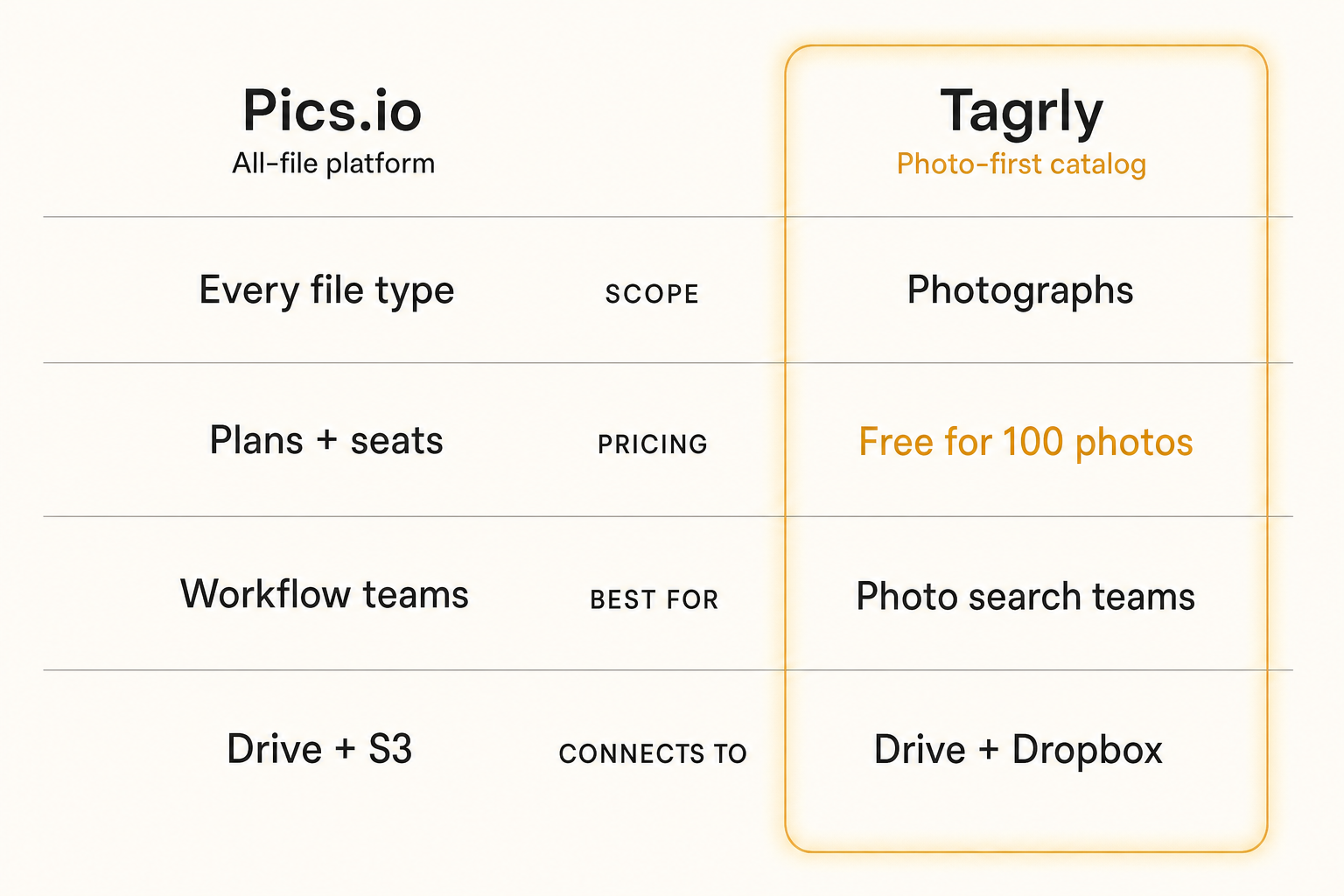
| Pics.io | Tagrly | |
|---|---|---|
| Shape | All-file-type asset platform | Photo-first searchable catalog |
| Works on your storage | Yes (Google Drive, Amazon S3) | Yes (Google Drive, Dropbox) |
| File types | 236, including video and design files | Photographs |
| AI tagging | Auto-tags, face recognition, text-in-image | Focal-subject method + editorial alt text |
| Workflow (versions, approvals, portals) | Yes | No |
| Pricing model | Seat-based plans, 7-day trial | Monthly subscription + free first 500 photos |
| Best audience | Teams managing mixed media with workflow | Teams searching a photo library |
Two rows deserve plain words. The storage row is a hard filter: Drive libraries can pick either tool, Dropbox libraries can only pick Tagrly, S3 buckets can only pick Pics.io. And the workflow row is the price you see on the invoice: Pics.io's versions, approvals, and portals are the platform you are paying platform prices for, so the honest test is whether your team used any of them last month.
Warning. "Works on top of your storage" does not mean the two tools read the same amount. A platform managing your assets needs broad access to manage versions and uploads; a read-only catalog only needs to look. Whatever you evaluate, check the permission screen at connection time and confirm the access level matches the job you are hiring the tool for.
How to choose: pick X if Y
Skip the feature checklist and answer one question: does your team need to manage assets, or find photos?
- Pick Pics.io if you manage mixed media on top of Google Drive or Amazon S3 and your team genuinely uses versions, approval loops, and branded portals. That combination is rare and Pics.io does it well.
- Pick Filecamp, Canto, or Image Relay if you want the same platform shape at a different price or interface. That is a lateral swap, not a category change.
- Pick Brandfolder or Bynder if brand governance is a mandate and procurement is in the room.
- Pick Tagrly if the library is photographs in Google Drive or Dropbox, the daily job is finding the right shot, and you would rather pay catalog prices than platform prices. The pricing tiers are built around library size, and the free first-100-photo tier lets you check the output before spending anything.
If you are torn specifically between Pics.io and Tagrly, the deciding question is what your team did in the tool last month. Approval rounds and portal publishing mean you are a platform customer; search-and-download means you are a catalog customer paying a platform bill.
For the wider category, our image catalog software buyer's guide maps every tier, and the cheap photo management software guide covers what $0 to $30 a month actually buys. The best Pics.io alternative is the one shaped like your team's real behavior, and for most photo-heavy teams that turns out to be a catalog rather than a second platform.
Frequently asked questions
What is the best alternative to Pics.io?
It depends on which half of Pics.io you actually use. If your team relies on the workflow platform, version control, approval loops, branded share portals, and support for video, PDFs, and design files, the closest alternatives are other full digital asset platforms like Filecamp, Canto, or Image Relay, and enterprise options like Brandfolder or Bynder if you have a governance mandate. If what your team really does is search a photo library and pull the right shot, a photo-first catalog is the better-shaped alternative. Tagrly is one example: it connects read-only to Google Drive or Dropbox, tags every photo with AI, and gives a team one searchable surface, priced as a small monthly subscription with the first 500 photos free.
What is the main difference between Tagrly and Pics.io?
Scope. Both tools work on top of cloud storage you already own rather than making you migrate files, which is why they get compared. Pics.io builds a full asset platform on that foundation: 236 file types, version control, approval workflows with comments, branded portals, face recognition, and role-based permissions. Tagrly deliberately does one job: it reads the photos in your Google Drive or Dropbox, tags each one with a focal subject, context tags, and a descriptive sentence, and makes the whole library searchable by what each photo shows. Pics.io answers 'manage every asset our team produces.' Tagrly answers 'find the right photo in a 20,000-image archive in seconds.'
Does Pics.io work on top of Google Drive?
Yes, and that is its most distinctive trait. Pics.io can run on top of a Google Drive or an Amazon S3 bucket you already own, or on its own storage, so your files stay in a storage account you control. Note the connector difference when comparing: Pics.io connects to Google Drive and Amazon S3 but not Dropbox, while Tagrly connects to Google Drive and Dropbox but not S3. If your library lives in Dropbox, that difference alone settles the comparison. If it lives in Google Drive, both tools can read it in place and the decision comes down to scope and price.
How much does Pics.io cost?
Pics.io publishes seat-based plans that scale from a solo tier up through team plans and a custom enterprise tier, with a 7-day free trial and no credit card required. As of writing in July 2026, third-party listings show the entry plan in the range of roughly $50 to $100 per month and team plans running several hundred dollars per month, but the numbers differ between review sites and change over time, so treat Pics.io's own pricing page as the only current source. The honest summary of the shape: you pay for a workflow platform priced by plan and seats, which is fair when a team uses the workflow and expensive when it only uses the search.
Can Tagrly replace Pics.io for video and design files?
No. Tagrly is a photo catalog, and it is deliberately narrow. It does not manage video, PDFs, or design files, it does not run approval workflows or version control, and it does not build branded client portals. If those features are on your requirements list, Tagrly will not replace Pics.io, and a lateral move to another full platform like Filecamp or Canto is the right comparison to run. Tagrly earns its keep when the library that matters is photographs and the daily job is finding the right shot fast, which is the one job it goes deeper on than the platforms.
When is Pics.io the right choice over Tagrly?
When you need the platform, not just the search. Pick Pics.io if your team manages mixed media, photos plus video, documents, and design files, and uses workflow features every week: version control on revisions, approval loops with comments, branded share portals, and role-based permissions, all running on top of a Google Drive or Amazon S3 you already own. That combination is genuinely rare and Pics.io does it well. You only outgrow it in the other direction: if the renewal math shows you are paying platform prices while the team only ever searches for photos, a photo-first catalog does that one job for far less.
Try Tagrly on your own photo library
Connect your Google Drive or Dropbox folder and Tagrly will tag every photo in bulk. Search by what is actually in the image, share specific shots with clients, and never lose a photo again.
- Free for your first 500 photos
- Read-only access, revoke anytime
- No credit card