
Your camera roll syncs to Google Photos, the client shoots live in a shared Drive folder, and Google now puts Gemini one click away in both. So can Gemini organize your photos, or does the AI stop where your library begins?
First, which Gemini are we talking about?
Two unrelated products share the name, and search results for this question mix them freely. Google's Gemini is the AI assistant built into the Gemini app, Google Photos, and Google Drive. Gemini Photos, by MacPaw, is an iPhone app that finds duplicate and blurry shots in your camera roll so you can delete them.
The MacPaw app is a storage cleaner, not an organizer, and it has nothing to do with Google's AI. The rest of this post is about Google's Gemini, because that is the one people hope will tag and sort a real photo collection.
What Gemini can actually do with your photos
Gemini reaches further into your photos than any other assistant. Unlike ChatGPT, which cannot see your folders at all, Gemini is wired into the two places Google already stores your images.
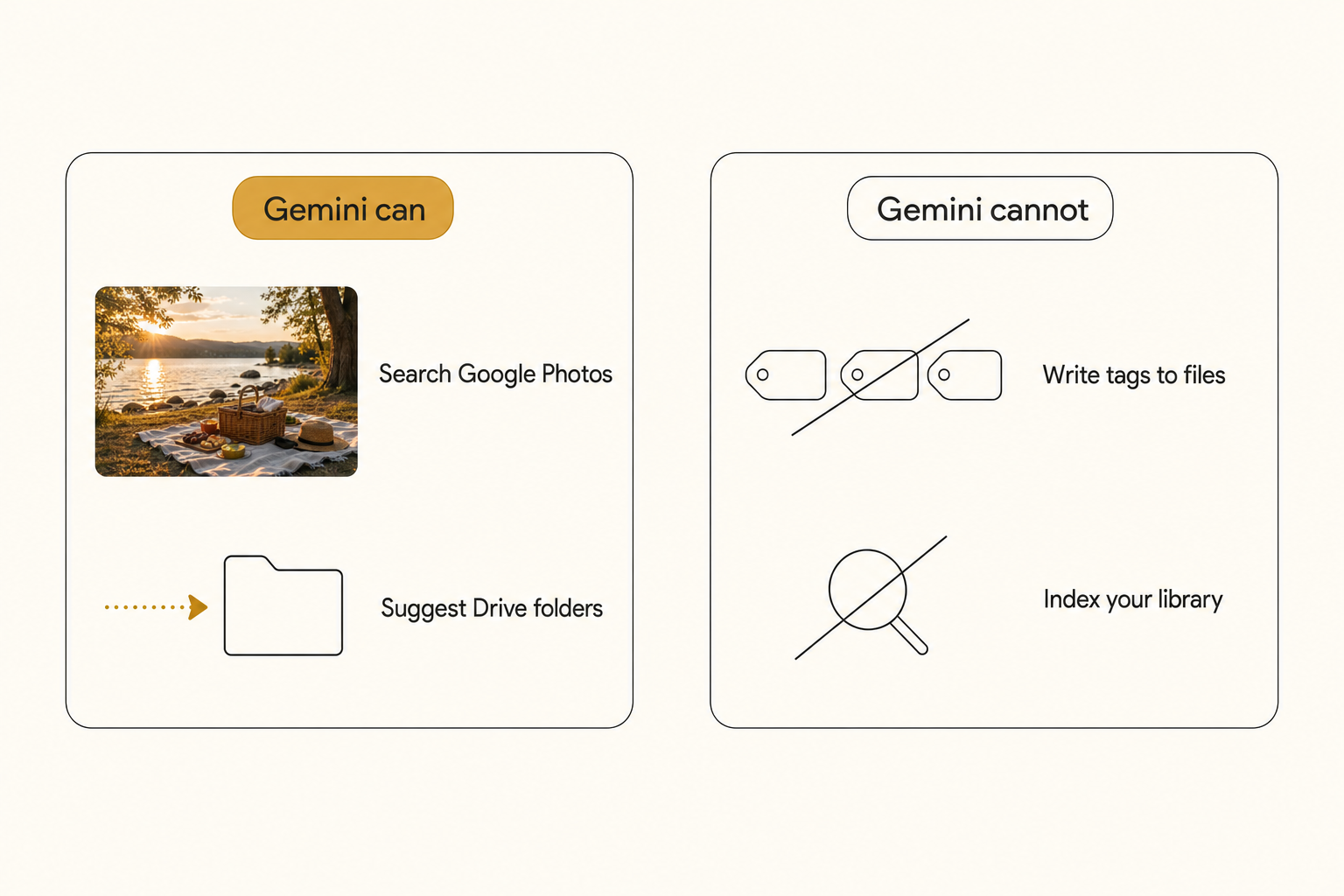
It searches your personal Google Photos. Connect Google Photos to the Gemini app and you can ask for "the photos from the lake trip last August" in plain language. Google's help page on searching your photos with Gemini covers the setup and availability. For a personal camera roll this is genuinely useful, and it asks no tagging work of you.
It answers questions about images in Drive. Open an image in Google Drive and the Gemini side panel can describe it, pull text out of it, or summarize a folder's contents, one conversation at a time. Google added image support to Gemini in Drive in 2025.
It tidies loose Drive files. On paid Workspace and Google AI plans, Gemini can read the loose files in My Drive, images included, and suggest folders to move them into. Details and eligibility are on Google's Let Gemini organize your files page; as of writing it works on the web in English only.
That list is real capability, not marketing. It is also where the good news ends for anyone holding a photo library rather than a camera roll.
Where Gemini stops on a working photo library
It writes nothing down. Ask Gemini about a photo and the answer arrives as chat text. No tag, keyword, or description is attached to the file, so the work evaporates when the conversation ends.
Ask Photos is personal, not professional. The Google Photos search runs on one personal account's library. It does not read a shared Drive folder, a Dropbox archive, or a shared drive, and there is no way to hand teammates your search. The client archive most teams worry about lives exactly where Ask Photos does not look.
Drive still cannot search photo content. The side panel answers questions about an image you have already found. Drive's search box still matches filenames and document text, not pixels, which is why Drive search misses most photos in a library full of IMG_4827.jpg files. Gemini's per-file answers feed no index.
A folder is not findability. Suggested file moves leave photos somewhere tidier, and tidier is nice. But a folder holds one dimension: file by client and the sunset shots vanish, file by year and the client's work scatters. Nobody remembers photos by folder. They remember what was in the frame.
Note. Gemini's data handling differs by plan, and Workspace accounts follow different rules than free personal ones. The five-check connection test in our guide to whether AI photo tagging is safe applies to assistants as much as to tagging tools.
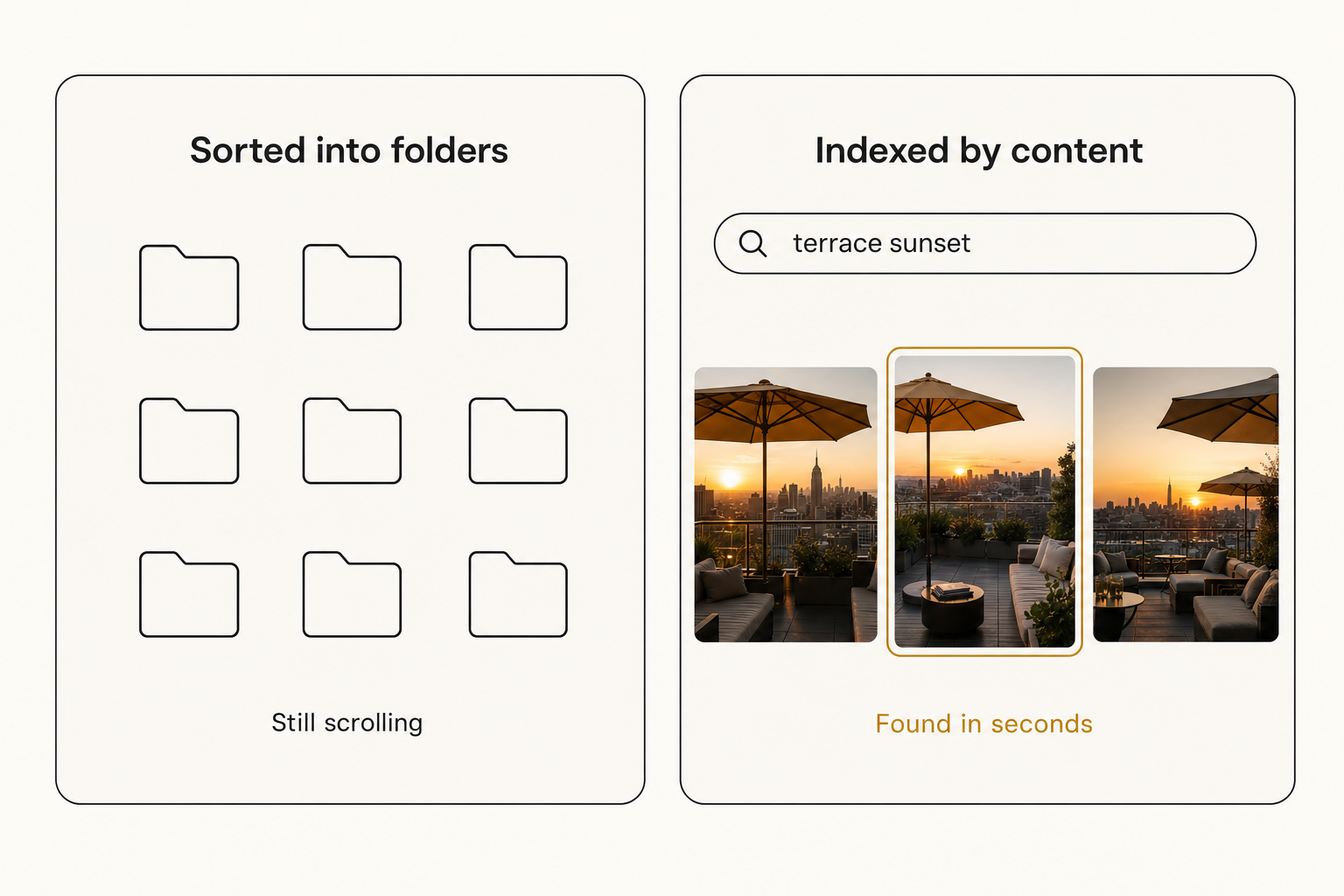
Folders sort photos. An index finds them.
The difference shows up on the first real request: "the terrace sunset shot from the spring launch, the one with the amber umbrellas." A folder tree answers that with twenty minutes of scrolling. An index answers in seconds, because every photo was described once, up front, and the descriptions are searchable.
Building that index by hand is the 1,000-photo wall: a skilled keyworder covers 100 to 200 photos per hour, which is 5 to 8 hours per 1,000, and most libraries grow faster than anyone types. Asking Gemini about photos one side panel at a time does not change that math, because a person still sits in every round trip.
Connected AI catalogs remove the person from the loop. They read a Drive or Dropbox folder with read-only access, run every photo through a vision model, and write a focal-subject label, tags, and a one-sentence description to a shared searchable index. Focal-subject tagging is the part that makes the search precise: the dominant element of each photo is identified first and ranked above the background context, so "amber umbrellas" returns the terrace shot, not every photo with an umbrella somewhere in it.
That full indexing pass ran unattended in the background.
Tip. Tagrly is one catalog in that category, and its free tier tags the first 500 photos in any Drive or Dropbox folder, no credit card. Point it at your messiest folder and search for a shot nobody ever named.
Which tool fits your photo library
- Pick Google Photos with Gemini if the collection is your personal camera roll on your own Google account. The natural-language search is tagging work you never have to do.
- Pick Gemini in Drive if your real problem is loose documents and general Drive clutter, and your plan includes the feature. Treat the photo help as a bonus, not the tool.
- Pick a desktop AI organizer like Excire Foto or Mylio if you work solo and the archive must stay on your own machine.
- Pick a connected AI catalog (Tagrly is one option) if the photos live in Drive or Dropbox and more than one person needs to find things in them.
So, can Gemini organize your photos? For a personal Google Photos library, better than any assistant before it. For a working archive in Drive or Dropbox, it stops at suggestions and chat answers: no tags written, no index built, nothing a team can search.
Past a thousand photos, that gap is the entire job. If you want to feel the difference on your own shots, run a free scan on a real folder and search it by what the photos show.
Frequently asked questions
Can Gemini tag my photos automatically?
No. Gemini can describe an image well: open a photo in the Google Drive side panel or upload one to the Gemini app and it will tell you what the shot shows. But the description arrives as chat text. Nothing is written to the photo's metadata, no keyword is attached to the file, and no searchable record is kept anywhere. For a handful of photos that is a useful free assist, since you can paste the output into a caption or a metadata field yourself. For a library of thousands, the copy-paste loop makes it slower than typing keywords by hand. Tools that tag photos automatically at scale work differently: they connect to the storage, run every image through a vision model, and write the results to a searchable index without a person in the loop.
Can Gemini organize photos in Google Drive?
Partially. On paid Workspace and Google AI plans, Gemini's file-organization feature reads loose files in My Drive, images included, and suggests folders to move them into. As of writing it runs on the web in English only, and you approve or reject each suggested move. That genuinely helps with clutter. What it does not do is describe your photos: no tags are written, Drive's search box still cannot match what is inside a JPEG, and a photo filed in a tidier folder is still only findable by its filename. If the goal is retrieving a specific shot from thousands, folder suggestions do not get you there.
Does Ask Photos work for a business photo library?
No. Ask Photos and the Gemini app's photo search run against one personal Google account's Google Photos library. They do not read a shared Drive folder, a shared drive, a Dropbox account, or any archive that lives outside Google Photos, and there is no way to give teammates access to your search. That covers the personal camera roll case well and leaves the professional case untouched, because client shoots and marketing archives almost never live in a personal Google Photos account. A team library needs a catalog that connects to the storage the team actually uses and shares one searchable index across every member.
Is Gemini Photos by MacPaw the same as Google's Gemini?
No, and the name collision confuses this whole topic. Gemini Photos by MacPaw is an iPhone app that finds duplicate and blurry photos in your camera roll so you can delete them and reclaim storage. It is a cleanup tool, not an AI assistant, and it has no connection to Google. Google's Gemini is the AI built into the Gemini app, Google Photos, and Google Drive. If you searched for whether Gemini can organize photos, the answer depends entirely on which product you meant: MacPaw's app deletes clutter on a phone, and Google's assistant searches and answers questions but writes nothing to your library.
What is the fastest way to make a large photo library searchable?
Index it once with a connected AI catalog. These tools read a Google Drive or Dropbox folder with read-only access, run every photo through a vision model, and write a focal-subject label, a set of tags, and a one-sentence description to a searchable index the whole team can use. That full pass ran unattended in the background. Tagrly is one example of the category, and its free tier covers the first 500 photos in any folder, so you can test the search on your own shots before paying anything.
Try Tagrly on your own photo library
Connect your Google Drive or Dropbox folder and Tagrly will tag every photo in bulk. Search by what is actually in the image, share specific shots with clients, and never lose a photo again.
- Free for your first 500 photos
- Read-only access, revoke anytime
- No credit card