
Claude has a reputation as the AI that actually does things with files: it writes code, runs in a terminal, and now sorts folders on your desktop. Meanwhile your shoots sit in cloud storage as eight thousand files named IMG_4827.jpg. So can Claude organize your photos, or does the file-wrangling reputation stop at your library?
First, which Claude are we talking about?
"Claude" is one name stretched across three surfaces that do very different things with photos, and mixing them up is how most answers to this question go wrong.
Claude chat, on the web and in the apps. Upload a photo and Claude will describe it, answer questions about it, pull text out of it, or draft a caption. One image per round trip, and nothing is written to the file.
Claude Cowork, the agent. Cowork gives Claude permission to read, create, move, and rename files in folders you choose, then works through multi-step jobs on its own. It launched as a research preview in January 2026 and sits on Claude's top-tier plans as of writing; check Anthropic's page for current availability.
Claude the vision model. The engine other software builds on. A photo tool can send images to Claude vision and get back structured descriptions, which is how Claude ends up organizing photos inside products that never show you a chat window. You never see this surface directly, and it is the one that works at scale.
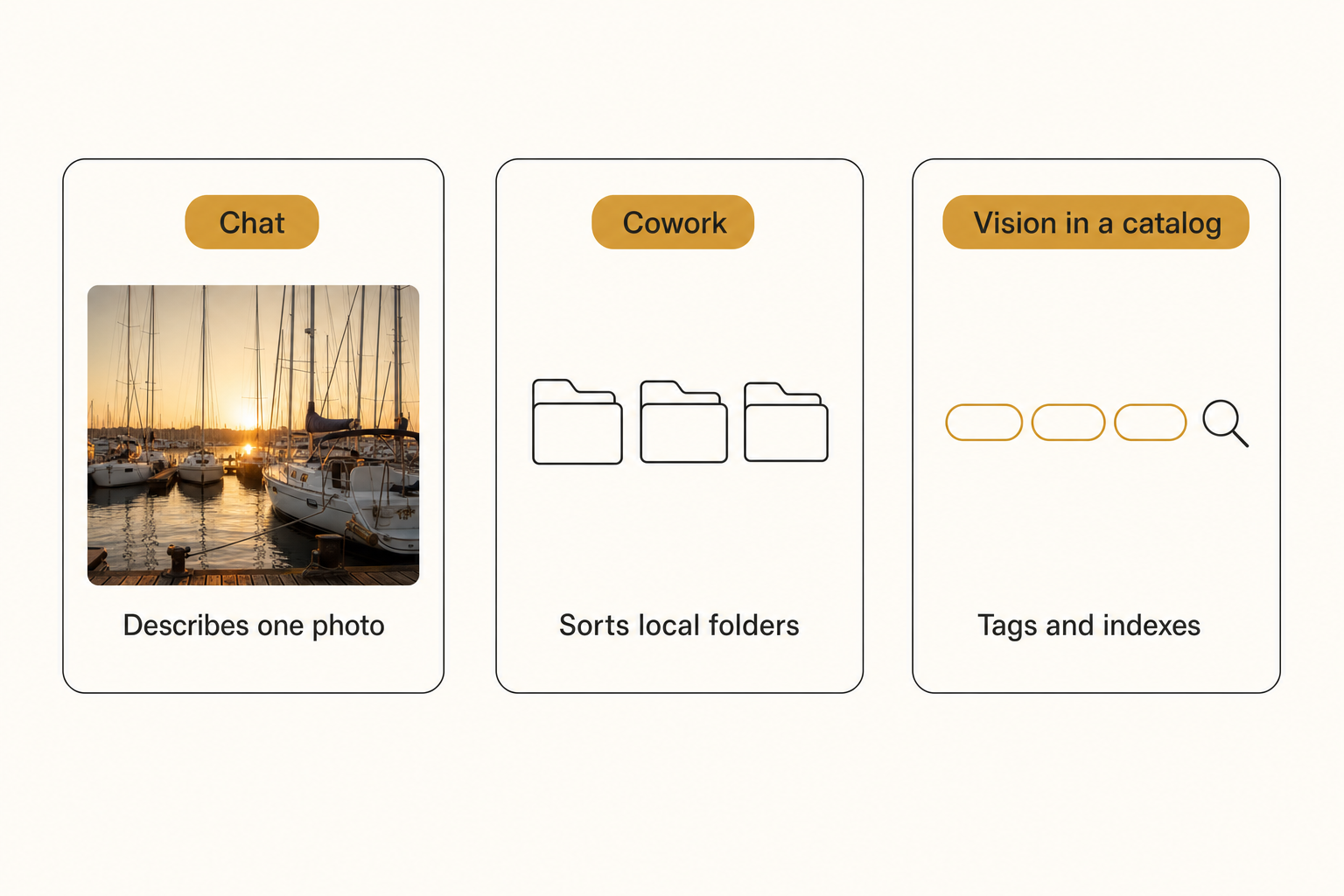
The rest of this post takes the three in order, because the honest answer is different for each.
What Claude can genuinely do with your photos
Chat describes a single photo well. Ask what is in a shot and you get a solid answer, a caption draft, or a first pass at alt text. For a handful of images this is a real free assist, the same one ChatGPT offers, and Claude's scene descriptions are consistently strong.
Cowork actually touches your files. Point it at a local folder, describe the structure you want, and it reads each image, builds subfolders, moves files into them, and renames everything to your pattern. Published hands-on tests have handed it folders of 500 unsorted photos and Downloads folders of 2,200 mixed files and gotten genuinely organized results back. Anthropic's getting-started guide covers the folder-permission flow. No other mainstream assistant does this today.
Claude Code scripts the repeatable version. If you are comfortable in a terminal, Claude Code can write and run a script that sorts photos by their embedded date or camera metadata. That is a one-off technical job rather than a product, but for technical users it is a fast way to impose order on a messy archive.
That list beats what ChatGPT, Gemini, or Copilot can offer, because Claude is the only one that writes real changes to real files. It is also where the good news ends for anyone holding a working photo library rather than a messy Downloads folder.
Where Claude stops on a working photo library
A folder tree holds one dimension. File by client and the sunset shots scatter; file by date and each client's work spreads across years. Cowork can build you a beautiful tree, but every tree makes that trade somewhere, because nobody remembers photos by folder. They remember what was in the frame.
The agent loop does not scale. Cowork reads, decides, and moves one batch at a time, with you approving permissions along the way. That is exactly right for 300 files on a laptop. On a professional archive it becomes days of supervised agent time on a subscription priced for chat, not for batch image processing.
A rename is not an index. 2024-06-marina-sunset.jpg beats IMG_4827.jpg, but a filename holds one line of information. No tags, keywords, or descriptions get written anywhere searchable, so "the dockside shot with the amber string lights" still means scrolling. Organized-looking is not the same as findable.
Your library probably is not on your desktop. Client work tends to live in Google Drive or Dropbox folders shared across a team. Cowork works in folders you grant on the machine it runs on, and while connectors can let Claude read some cloud files, there is no supported path today that walks a 50,000-photo Drive archive and organizes it in place.
Note. Client photos deserve a data check before any AI touches them, whatever the tool's reputation. The five-check test in our guide to whether AI photo tagging is safe takes ten minutes and applies to agents as much as to tagging tools.
The twist: Claude already organizes photos at scale
Most write-ups of this question stop at the chat window. Claude organizes photos for a living, just not there.
Connected AI catalogs are the products built on the third surface. They connect to a Google Drive or Dropbox folder with read-only access, run every photo through a vision model, and write a focal-subject label, a set of tags, and a one-sentence description to an index the whole team can search.
Several of them run Claude vision as that engine; Tagrly is one, and Anthropic's vision documentation shows the kind of structured output the model returns. We cover what Claude vision sees that other models miss in a separate post if you want the output-quality detail.
The difference is removing the human round trip. Manual keywording, or chat-assisted keywording, runs 100 to 200 photos per hour. That pace is the 1,000-photo wall that makes every library opaque past a few thousand images.
A catalog pass is a pipeline instead: The full Claude-vision indexing pass ran unattended in the background.
Focal-subject tagging is what keeps the result precise rather than noisy. The dominant element of each photo is identified first and ranked above the background context, so a search for "amber string lights" returns the dockside dinner shot instead of every photo with a light bulb somewhere in it.
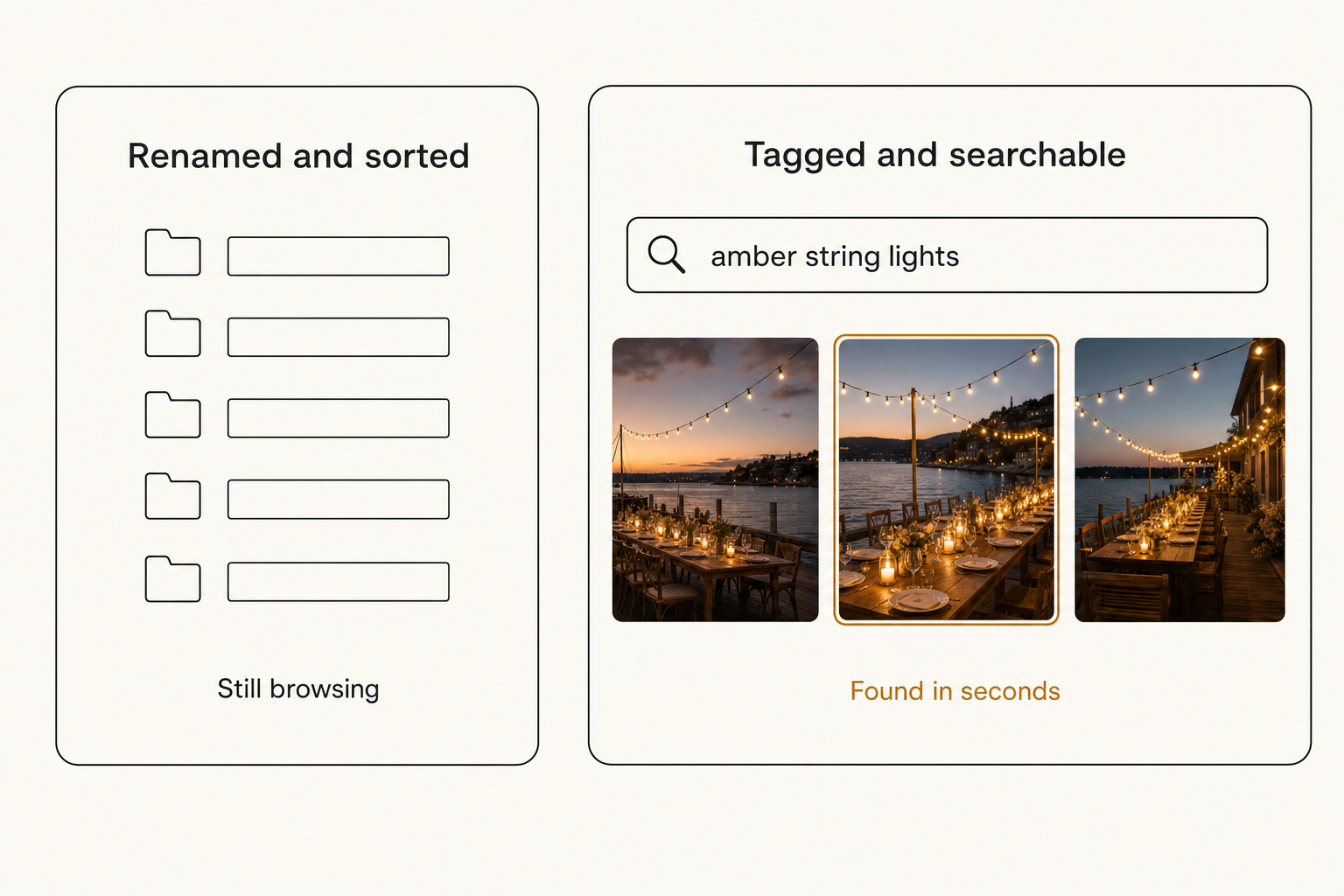
Tip. Tagrly is one catalog in that category and runs on Claude vision. Its free tier tags the first 500 photos in any Drive or Dropbox folder, no credit card. Run it on your messiest folder and search for a shot nobody ever named.
Which tool fits your photo library
- Use Claude chat for one-off image work: describe a shot, draft a caption, rough out alt text. Treat it as a helper, not an organizer.
- Use Claude Cowork if the mess is a local folder of a few hundred files and you already pay for a top-tier plan. It is the best folder-tidier of the assistant generation.
- Use Claude Code if you are technical and want a repeatable script that sorts by date, camera, or filename pattern.
- Pick a desktop AI organizer like Excire Foto if you work solo and the archive has to stay on your own machine.
- Pick a connected AI catalog (Tagrly is one option) if the photos live in Drive or Dropbox and more than one person needs to find things in them.
So, can Claude organize your photos? Closer than anything else you can chat with: it will genuinely rename and sort a local folder, and its vision model is the engine inside catalogs that index whole libraries. What no Claude app gives you today is the index itself, searchable tags across every photo, where the photos actually live, for the whole team.
Past a thousand photos, that gap is the entire job. The fastest way to feel the difference is to point a free scan at a real folder and search it by what the photos show.
Frequently asked questions
Can Claude Cowork organize my photo folders?
Yes, within its lane. Cowork is Anthropic's agent that you grant permission to specific folders; it reads the files, builds subfolders, moves images into them, and renames everything to a pattern you describe. Published hands-on tests have handed it a few hundred unsorted photos and gotten genuinely organized folders back. The limits matter, though. It launched as a research preview in January 2026 and sits on Claude's top-tier plans as of writing, it works through files in a supervised loop that suits hundreds of photos rather than tens of thousands, and the result is a tidier folder tree, not a searchable index. No tags or descriptions are written anywhere you can query later, and it does not reorganize a shared Google Drive or Dropbox archive where team libraries usually live.
Can Claude tag photos so they become searchable?
Not from the chat window or from Cowork. Neither writes keywords, tags, or descriptions to your photos or to any index, so nothing becomes searchable after the conversation ends. The Claude vision model is a different story: connected photo catalogs send every image in a library through it and store the returned focal-subject label, tags, and one-sentence description in a searchable index. That is Claude tagging photos at scale, delivered through a pipeline instead of a chat. Tagrly is one example of the category and runs on Claude vision, which is why a search like 'amber string lights' can surface one specific dockside shot out of thousands.
Is Claude better at organizing photos than ChatGPT, Gemini, or Copilot?
At touching files, yes. ChatGPT cannot reach your folders at all, Gemini can answer questions about photos in Google's services but writes nothing back, and consumer Copilot stops at chat answers with a narrow tagging feature locked inside SharePoint for business tenants. Claude's Cowork agent genuinely moves and renames files on your computer, which none of the others do today. The ceiling is shared, though: none of the four builds a searchable index of a working photo library, none writes reusable tags where your photos actually live, and none turns a 20,000-photo archive into something a team can search by content. For that job the answer is the same regardless of which assistant you pay for: index the storage once with a connected catalog.
What does it cost to organize photos with Claude?
It depends which surface you use. Describing individual photos in Claude chat is available on the free tier. Cowork, the agent that can actually sort your folders, requires one of Claude's top-tier plans as of writing; check Anthropic's pricing page for current numbers, since availability has been expanding through 2026. Connected catalogs built on Claude vision price separately from Anthropic, usually as a subscription or per photo indexed. Tagrly's free tier covers the first 500 photos in any Google Drive or Dropbox folder with no credit card, which is enough to judge the output quality on your own shots before paying anything.
What is the fastest way to make a large photo library searchable?
Index it once with a connected AI catalog. These tools read a Google Drive or Dropbox folder with read-only access, run every photo through a vision model, and write a focal-subject label, a set of tags, and a one-sentence description to a searchable index the whole team can use. That full pass ran unattended in the background. Compare that with manual or chat-assisted keywording at 100 to 200 photos per hour, and the gap only widens as the library grows.
Try Tagrly on your own photo library
Connect your Google Drive or Dropbox folder and Tagrly will tag every photo in bulk. Search by what is actually in the image, share specific shots with clients, and never lose a photo again.
- Free for your first 500 photos
- Read-only access, revoke anytime
- No credit card