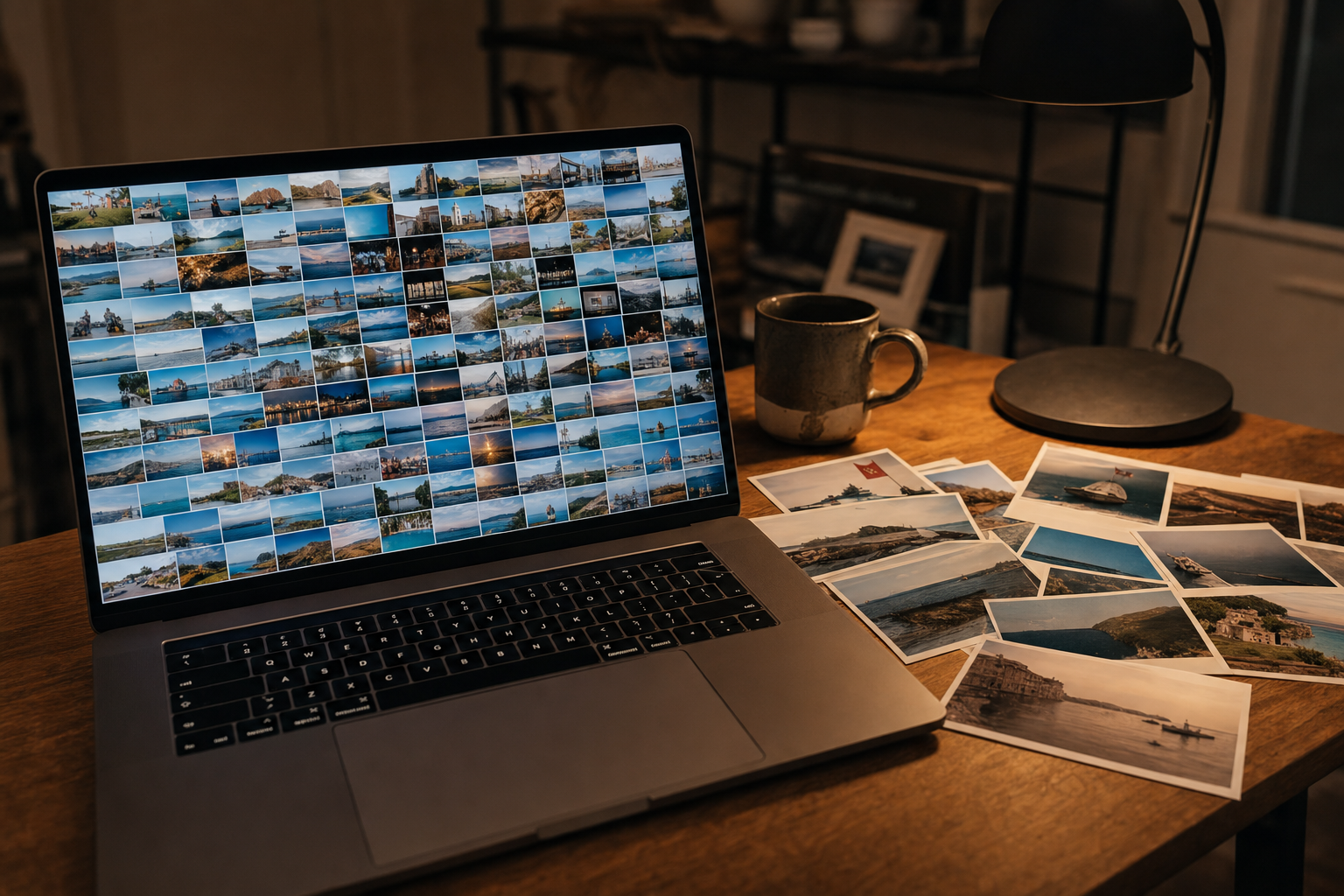
You already pay for ChatGPT, and you have 12,000 photos in a Dropbox folder with names like IMG_8203.jpg. So can ChatGPT organize your photos for you? Asking the AI you already own feels like the obvious first move.
What ChatGPT can actually do with your photos
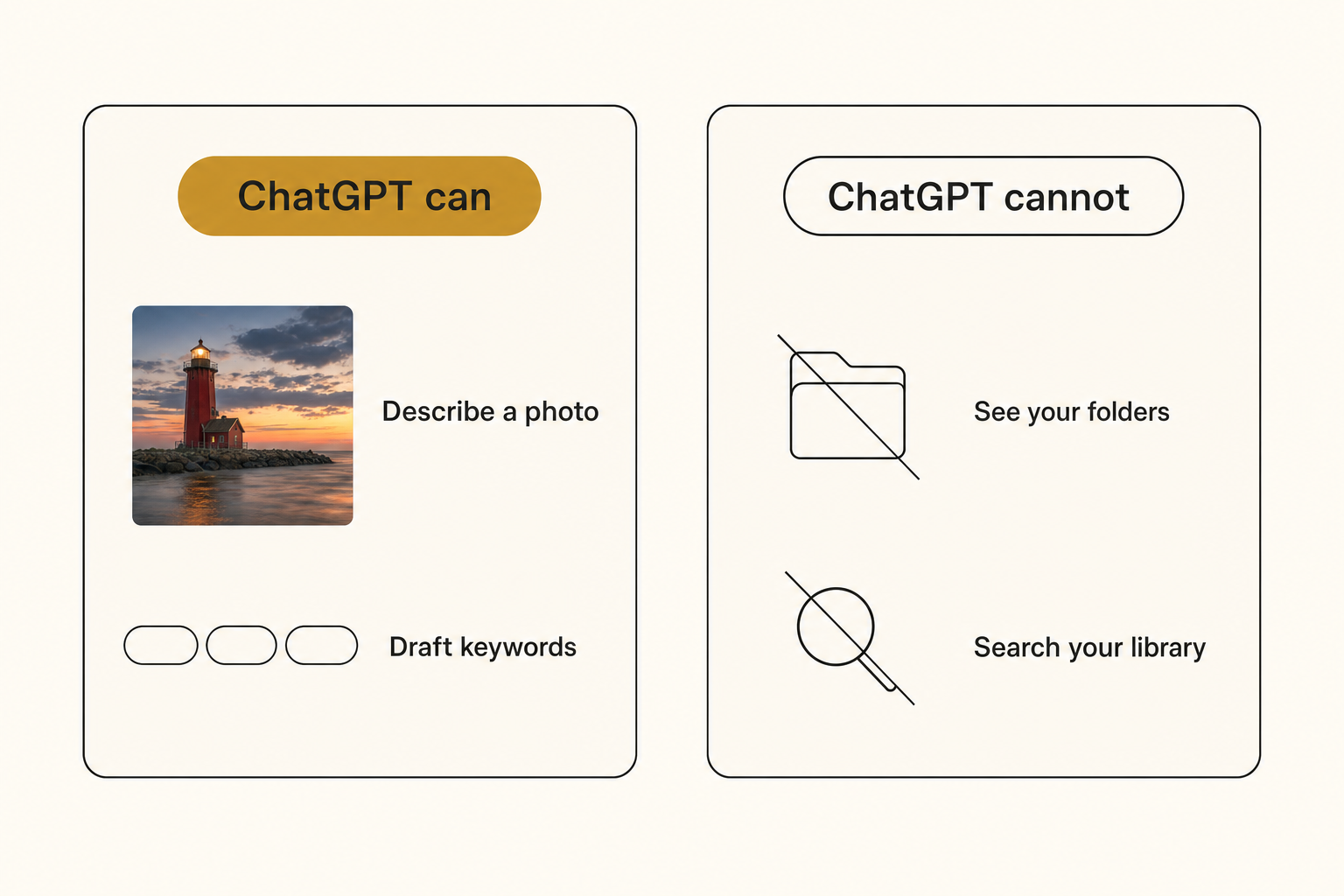
Upload a photo into a chat and ask what it shows, and the answer is impressive. Modern chat models name the focal subject, the setting, the light, and the mood, and they write it in clean prose.
That makes ChatGPT genuinely useful for small photo jobs:
- Describing a photo. "A red lighthouse on a rocky point at dusk, waves breaking below" is real, usable output.
- Drafting keywords. Ask for 15 search keywords and you get a sensible list, ready to edit.
- Writing alt text and captions. One photo, one paste, done.
- Planning. It will happily design a folder structure or a naming convention for you.
Working photographers use this for real. Photographer Charles Bush documented a workflow that runs selects through ChatGPT to draft captions and keywords, then pastes the output into each photo's metadata fields. For the ten best frames of a shoot, it works well.
The catch is the word "pastes." Everything ChatGPT knows about your photo arrives as chat text, and chat text is where the trouble starts.
The four walls between ChatGPT and a real photo library
Wall 1: it cannot see your folders. ChatGPT only knows about photos you hand it, one message at a time. Some paid plans offer connectors that pull individual files into a conversation, but as of writing there is no mode that walks a Dropbox folder of 12,000 images and tags what it finds.
Wall 2: uploads are capped. Chat uploads are built for a few images per message, not for bulk. Exact limits vary by plan and change often, so check the current docs, but no chat plan is designed to swallow a photo archive.
Wall 3: the output is not attached to anything. The keywords come back as text in a chat window. Your files do not change. To make the work stick, you copy each answer into a metadata field by hand, one photo at a time.
Wall 4: nothing is searchable afterward. A photo library is only organized if you can find things in it later. ChatGPT keeps no index of what it saw, and scrolling old chat threads is not photo search.
Note. On consumer plans, uploaded images may be used for model training depending on your data settings, and the policies change; check your plan's data controls before uploading anything shot under contract. The full connection checklist in our guide to whether AI photo tagging is safe applies to chatbots too.
The math: tagging 1,000 photos through a chat window
Say you push through anyway. The loop per photo is: find the file, upload it, wait for the response, copy the keywords, paste them into a metadata field, save. Around two minutes per photo when everything cooperates. That is roughly 33 hours per 1,000 photos, before any breaks.
Compare that to plain manual keywording. A skilled keyworder typing into Lightroom or Bridge runs 100 to 200 photos per hour, which is 5 to 8 hours per 1,000. The chat loop is slower than typing, because the human is still in every single round trip. ChatGPT saves the thinking, not the time.
Both approaches fail at the same place: the 1,000-photo wall, the point where a library goes opaque faster than any person can describe it. Past that wall, the fix is removing the human from the loop, not upgrading the chatbot.
For scale reference: A connected AI catalog's full indexing pass runs unattended in the background. Same class of vision model, different plumbing.
Three paths to a photo library you can actually search
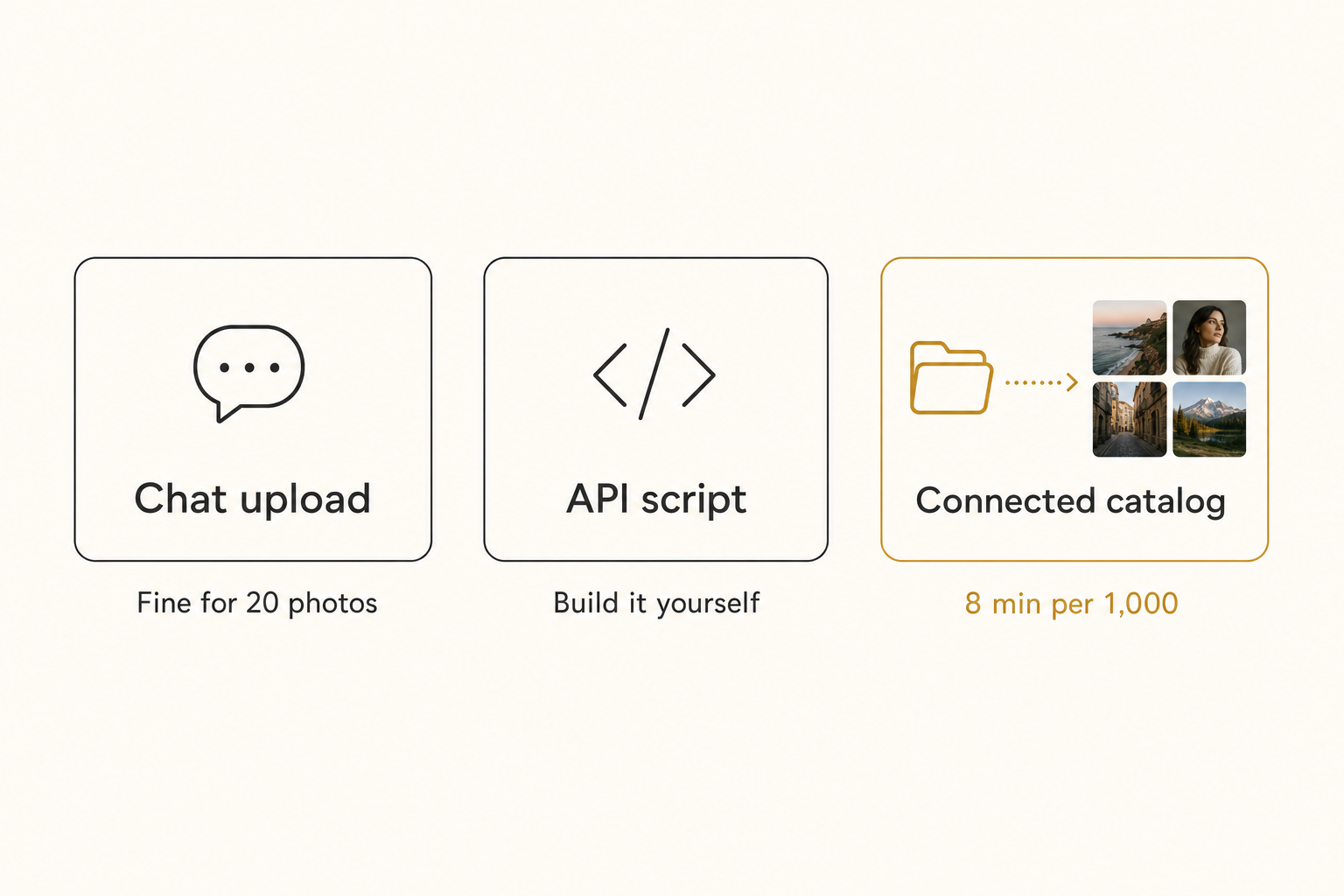
Keep the chat, add a metadata editor. For a shoot's selects or a small product set, the Charles Bush pattern is fine: ChatGPT drafts, you paste into IPTC fields with your editor or a free tool like ExifTool. The desktop keyworder tools that automate this loop are covered in our guide to automatic photo keywords.
Script a vision API. Developers can skip the chat window and call the same models directly: OpenAI's vision API or Anthropic's Claude vision API will tag photos programmatically. Be honest about what you are signing up for, though: you are building ingest, a vision pass, an index, and search yourself, the same four-step pipeline every tagging product implements. Our plain-English explainer on how AI photo tagging works maps those steps.
Connect a catalog to your storage. A connected AI catalog reads your Google Drive or Dropbox folder with read-only access, runs every photo through a vision model, and writes a focal-subject label, tags, and a one-sentence description to a searchable index the whole team shares. The good ones use focal-subject tagging: the dominant element of each photo is identified first and ranked above the background context, so a search for "red lighthouse" returns photos of the lighthouse, not every shot with one in the distance. Tagrly is one example in this category; your originals never move and nothing is uploaded by hand.
Tip. The fastest way to settle this for your own library: Tagrly's free tier tags the first 500 photos in any Drive or Dropbox folder, no credit card. Run it on a folder ChatGPT would choke on and search for a shot nobody ever tagged.
Which path fits your photos
- Pick ChatGPT if you have a one-off job under about 100 photos: captions for a gallery, keywords for a submission, alt text for a page. It is free or already paid for, and the output quality is real.
- Pick ChatGPT plus a metadata editor if you are a solo photographer who wants embedded IPTC keywords and does not mind the paste loop on selects.
- Pick a vision-API script if you are a developer who wants full control and accepts owning the pipeline.
- Pick a desktop AI keyworder like Excire Foto if your photos must never leave your machine.
- Pick a connected AI catalog (Tagrly is one option) if the library runs to thousands, it lives in Drive or Dropbox, and more than one person needs to find things in it.
So, can ChatGPT organize your photos? A few at a time, yes, and honestly well. As a library tool it fails on plumbing, not intelligence: it cannot reach your folders, cannot write to your files, and cannot remember what it saw.
Once a collection passes a thousand photos, the job belongs to software that connects to your storage and indexes everything for you. If you want to see the difference on your own shots, test a real folder for free and compare the results side by side.
Frequently asked questions
Can ChatGPT tag photos automatically?
For a few photos at a time, yes. Upload images to ChatGPT and ask for tags, keywords, or a description, and it returns good ones: the focal subject, the setting, the mood. But the tags arrive as chat text, not as metadata on your files. Nothing is written to the photos themselves, so you have to copy each set of keywords into a metadata field by hand. There is also no library index: after the chat ends, nothing about your collection is searchable. For a handful of images it is a genuinely useful free tool. For hundreds or thousands, it becomes a manual copy-paste job that is slower than typing keywords yourself.
Can ChatGPT see the photos in my Google Drive or Dropbox?
Not the way a photo tool does. Some paid plans offer connectors that can pull individual files into a conversation, but as of writing there is no mode where ChatGPT walks an entire photo folder, tags every image, and writes anything back. Every photo it analyzes is one you handed it inside the chat. Tools built for photo libraries work the other way around: they connect to Drive or Dropbox with read-only access, stream every photo through a vision model, and store the results in a searchable index while the originals stay exactly where they are.
Is it safe to upload client photos to ChatGPT?
Treat it as a decision, not a default. On consumer plans, uploaded images may be used for model training depending on your data settings, and those policies change, so check the current data controls on your plan before uploading anything you shot under contract. Client contracts often restrict who may process the images at all. Business tiers typically exclude training, but you still have no record of which photos went where. The safer pattern for client work is a tool with read-only storage access, a written no-training policy, and a clean export path, the same checklist you would run on any AI tagging service.
How many photos can ChatGPT handle at once?
A handful per message. Upload limits vary by plan and change over time, but chat uploads are designed for a few images at a time, not for bulk processing. Even where the limits are generous, each batch still needs a person to select files, wait for the response, and copy the output somewhere useful. That loop is the real cap: about two minutes per photo in practice, or roughly 33 hours per 1,000 photos. Purpose-built tagging tools process the same 1,000 photos unattended in the background, because they read directly from storage and write results to a database with no human in the loop.
What is the fastest way to organize thousands of photos with AI?
Connect the storage instead of uploading the photos. A connected AI catalog reads a Google Drive or Dropbox folder with read-only access, runs every photo through a vision model, and writes a focal-subject label, a set of tags, and a one-sentence description to a searchable index. That pass runs unattended in the background. Tagrly is one example of the category, and its free tier covers the first 500 photos in any folder if you want to compare its output to ChatGPT's on the same shots.
Try Tagrly on your own photo library
Connect your Google Drive or Dropbox folder and Tagrly will tag every photo in bulk. Search by what is actually in the image, share specific shots with clients, and never lose a photo again.
- Free for your first 500 photos
- Read-only access, revoke anytime
- No credit card