
It is the third email this month from the same client: "can you send over the rooftop shots from the spring launch?" The gallery you delivered in April holds 600 photos, the client has the link, and the only way through it is scrolling.
What makes a photo gallery searchable for clients
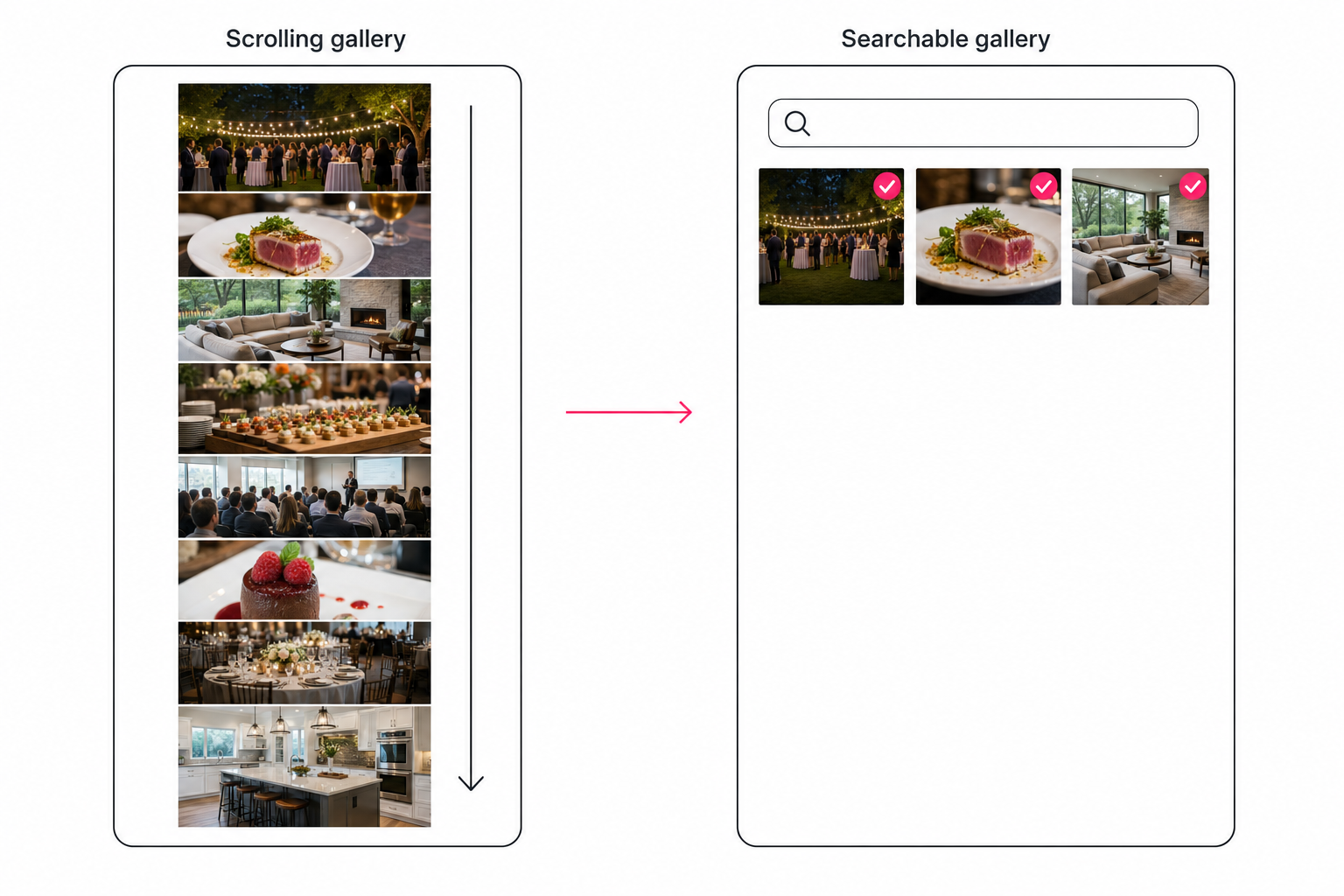
A searchable client gallery has two parts: a link the client can open without an account, and an index behind it that knows what each photo shows. The search box is the easy half. What it searches against is the whole feature.
There are three levels of "search" in client galleries, and vendors rarely say which one they mean:
- Filename search. Matches
DSC_0481.jpgif the client somehow knows the filename. On real deliveries, they never do. - Manual sets and tags. Someone (you) groups photos into labeled sections. Useful, but the labels only cover what you predicted the client would ask.
- Content search. An AI pass has tagged every photo by what is actually in it, so "string lights" finds string lights. This is the only level that answers questions you did not predict.
The distinction matters because the client's questions arrive months after delivery, phrased in their words, not your folder names. A gallery that cannot answer them turns you into the search engine.
Why the usual client gallery links are scroll-only
The standard free delivery links move photos reliably and answer nothing. Each one opens as a page the client can only scroll.
Google Drive and Dropbox links
A Drive folder link drops the client into a file listing: thumbnails, filenames, your folder structure. Google's own sharing documentation covers roles and access, but nothing about the viewing experience changes the core problem: filename matching is the best case, and filenames carry no content. Dropbox shared links behave the same way. We covered the clean delivery setup in sharing photos with clients from Google Drive; it is the right free method, and it is not searchable.
Google Photos shared albums
A shared album is the friendlier free gallery: a clean scrolling page with comments. But the visitor gets no search box, as of writing in August 2026. Google Photos' impressive search works on your own library while you are signed in, not on an album someone shared with you.
The math on scrolling
Scroll-only is fine at 40 photos. At 600 it is a chore, and at a few thousand it fails completely: the client either scrolls until they give up or emails you, and you become the retrieval layer for a library you already delivered.
If your deliveries are small curated sets, stay free and see how to share specific photos with clients. This post is for when the questions keep coming.
Proofing galleries organize, but they do not search by content
Proofing tools like Pixieset, Pic-Time, ShootProof, and CloudSpot are the photographer's standard answer, and for shoot-by-shoot delivery they earn it: branded pages, client favorites, watermarked proofs, download controls. If your client is a wedding couple flipping through one gallery of finals, buy one of these and stop reading.
Their organizing model is sets and favorites, though, not content search. Where a search feature exists it generally matches filenames; features vary by vendor and change often, so check their current pages before choosing.
The structure works because a shoot gallery is small and fresh. It stops working when the "gallery" is really an archive: a retainer client's two years of campaigns, a venue's event history, a brand's full product library. Nobody builds enough sets to cover every question a client will ask in month eight.
How a searchable client gallery actually works
The content-search route runs through a catalog. An AI tagging pass reads every photo in your Drive or Dropbox and records what it shows: one focal subject, supporting context tags, and a line of alt text.
The focal-subject part matters, because ranking the dominant subject above background context is what makes "rooftop at dusk" return photos of rooftops instead of every frame containing sky. The full method lives in our complete guide to AI photo tagging, and vision models like Claude vision are what made this practical at library scale.
Once the index exists, a client gallery becomes a boundary drawn over it: a curated collection or a saved search, shared as its own link, with the search box scoped to what is inside. Three properties fall out of that design:
- The client self-serves. They type their question in their words. The gallery answers it, not your inbox.
- It stays current. A gallery defined as "everything tagged spring launch" picks up next month's approved shots automatically.
- The boundary holds. The client searches inside their gallery only. Other clients' work and your outtakes are not in the index they can reach, and the storage connection is read-only, so originals never leave your Drive or Dropbox.
Without a searchable gallery, a typical partner request is an email asking for 20 to 40 specific photos. With one, the same partner runs the search themselves. The tagging pass that makes it possible runs unattended in the background; typing tags by hand at the same depth runs 5 to 8 hours per 1,000 photos.
Tip. You can test this on your own photos before any client sees it. Tagrly's free tier tags the first 500 photos in any Drive or Dropbox folder, no credit card, so search a sample of your library and judge the results on shots you know.
Which client gallery setup fits you
Honest guidance, since a searchable gallery is not always the right buy:
- A few finals, occasionally. A Drive delivery folder or a Google Photos album. Free, five minutes, no search needed at that size.
- Shoot-by-shoot client photography. A proofing gallery like Pixieset or Pic-Time. Favorites, watermarks, and print sales matter more than content search for a single shoot.
- Retainer clients, venues, or agencies who keep asking the archive questions. A searchable catalog gallery. Tagrly is one option; Pics.io also connects to Drive and covers similar ground.
- A full-library handoff at contract end. That is a transfer, not a gallery. See how to send a photo library to a client.
A searchable photo gallery for clients earns its keep on one signal: repeated "can you find me" emails against photos you already delivered. When those start, the fix is not a better folder structure, it is an index the client can query, and testing the search on 100 of your own photos is the fastest way to judge whether the results are good enough to hand to a client. The wider discipline of making a big library findable in the first place is covered in our pillar guide to finding any photo in your library.
Frequently asked questions
What is a searchable photo gallery for clients?
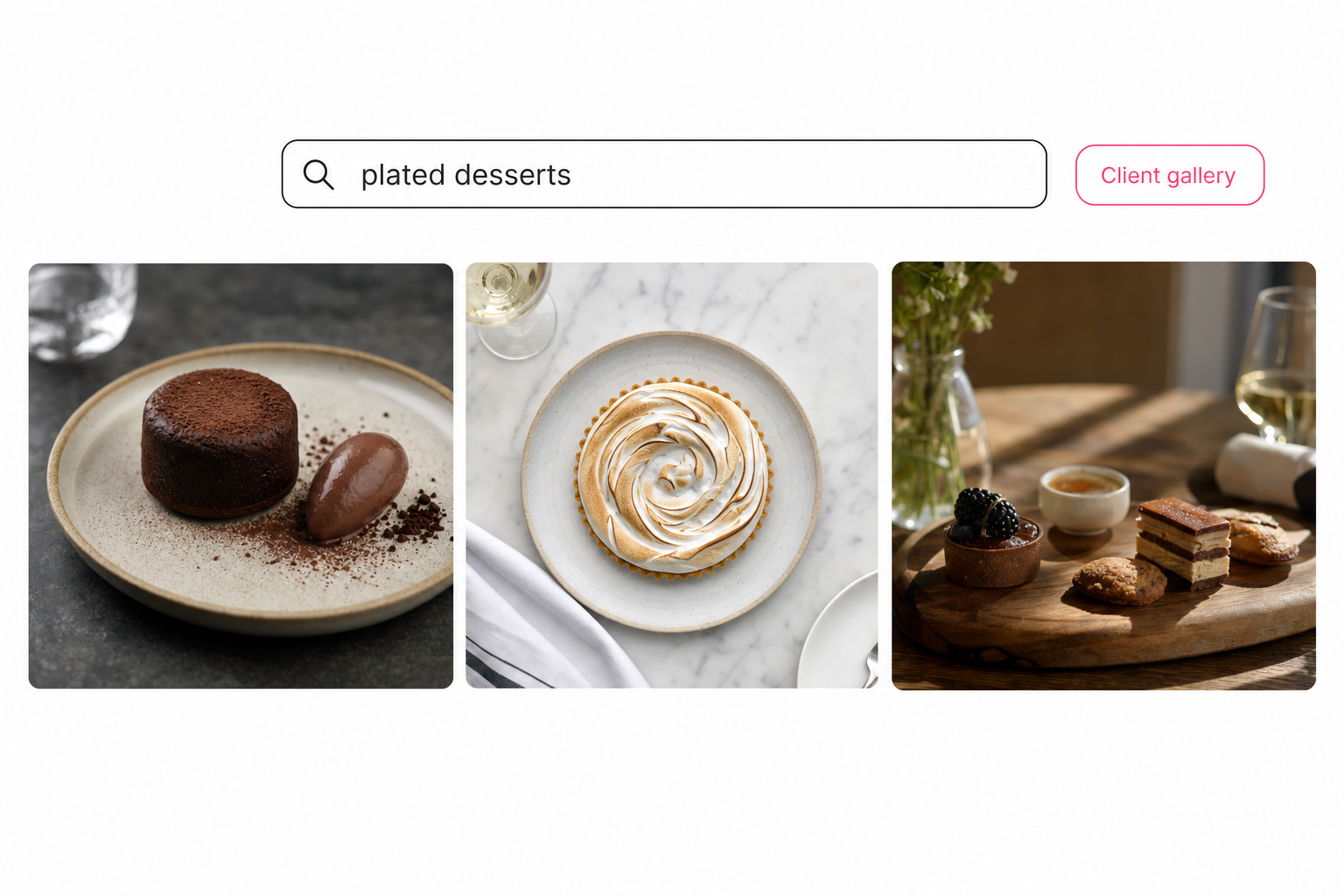
A searchable photo gallery for clients is a shared gallery with a working search box, where the search reads what is in each photo rather than just the filename. The client types 'rooftop at dusk' or 'plated desserts' and gets the matching shots without emailing you. That requires two parts: a gallery link the client can open without an account, and a tagged index behind it that knows what every photo shows. The gallery page is the easy half; most tools have one. The index is the hard half, and it is what separates a searchable gallery from a scrolling one.
Can clients search a shared Google Drive folder or Google Photos album?
Not in any useful way. A Google Photos shared album opens as a scrolling page with no search box for the visitor, as of writing in August 2026. A Drive folder link drops the client into a file listing where filename matching is the best case, and filenames like DSC_0481.jpg carry no information about what the photo shows. Dropbox shared links behave the same way. These links move photos perfectly well, which is why they are the default for one-off deliveries. They just answer no questions, so every 'which shot was it' email comes back to you.
Do proofing galleries like Pixieset or ShootProof have content search?
They organize rather than search. Proofing galleries arrange photos into sets, let clients mark favorites, and handle watermarks and downloads, which is exactly right for delivering a shoot. Where a search feature exists it generally matches filenames, not photo content, though features vary by vendor and change often, so check their current pages. For a wedding client flipping through one gallery of finals, sets and favorites are enough. For a client who comes back months later asking for 'the shots with the string lights', a filename search cannot help, because nobody names files that way.
How do photos become searchable in a client gallery?
An AI tagging pass reads every photo and writes down what it shows: a focal subject, supporting context tags, and a line of alt text, all stored in an index. The gallery's search box queries that index, so 'terrace at sunset' matches photos of terraces even when the filename is a camera serial number. A pass like this runs unattended in the background. Manually typing tags at the same depth runs 5 to 8 hours per 1,000 photos, which is why almost nobody does it by hand.
Is a searchable client gallery safe for the rest of my library?
It should expose only what the search behind it returns. In a catalog tool, a client gallery is a saved search or a curated collection over your library, shared as its own link. The client sees the photos inside that boundary and nothing else, so other clients' work and your reject frames stay private. The connection to your storage is read-only in the tools built this way, meaning originals never move out of your Google Drive or Dropbox and nothing gets renamed or deleted. Before sharing any gallery, open the link in a private browser window and confirm the boundary holds.
Try Tagrly on your own photo library
Connect your Google Drive or Dropbox folder and Tagrly will tag every photo in bulk. Search by what is actually in the image, share specific shots with clients, and never lose a photo again.
- Free for your first 500 photos
- Read-only access, revoke anytime
- No credit card