
The retainer ended in June, and the client's new agency wants everything: three years of campaign shoots, roughly 38,000 photos spread across your team's Google Drive. The fast move, sharing the parent folder, would hand them your working files, every reject, and the shoot you did for a different client one level up.
Copy or access: the first decision when you send a photo library
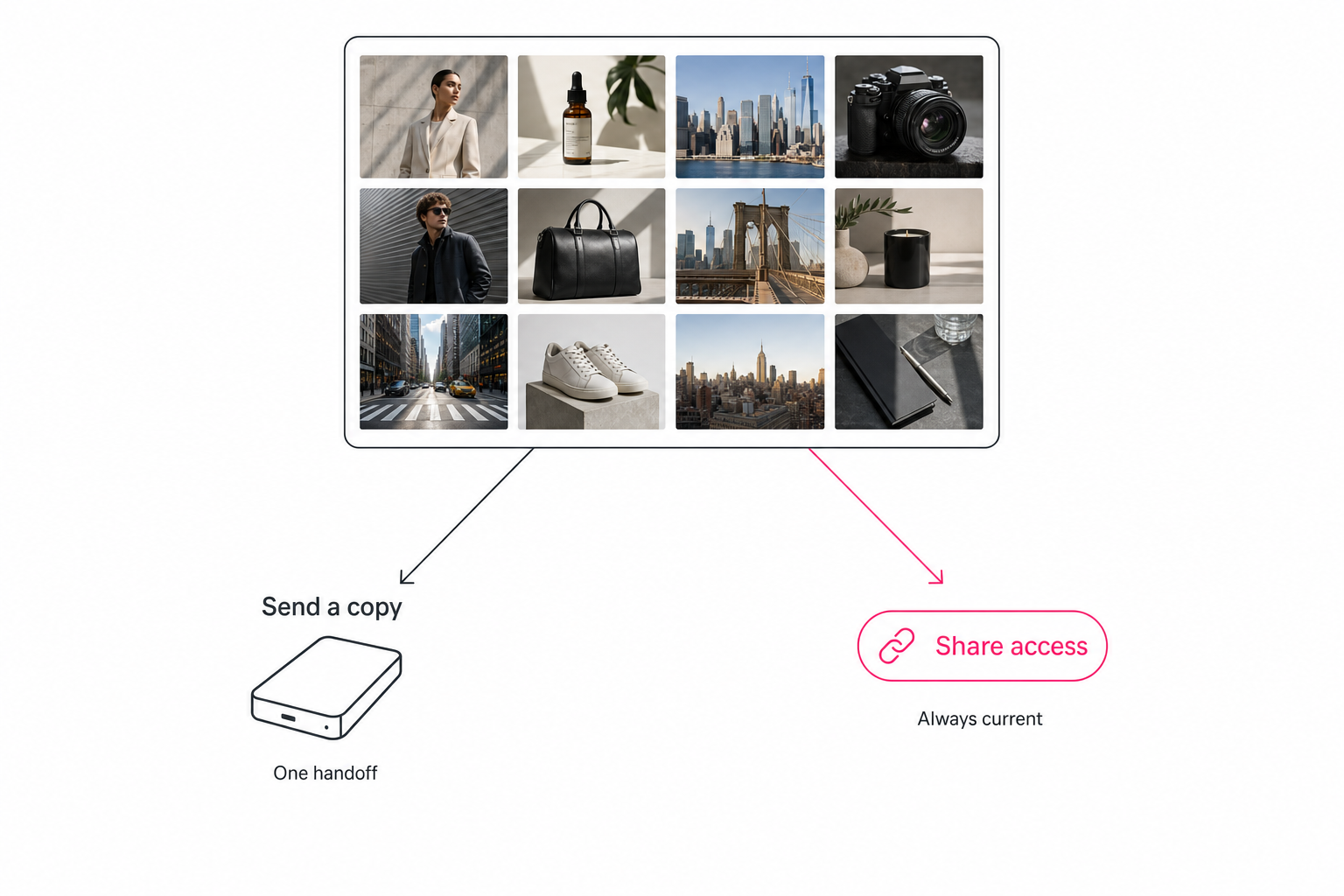
"Send the library" hides two different jobs, and picking the wrong one causes most handoff pain. A copy is a transfer of ownership: the client gets the files on their own storage, the responsibility moves with them, and you can archive your side. Access is a standing arrangement: the photos stay in your storage, the client browses and pulls what they need, and there is always exactly one current version.
The copy is right when the contract is closing and the deliverables belong to the client. Its cost is a fork: any photo edited after the handoff now differs between two libraries, and nobody notices until a stale version ships in a campaign.
Access is right when the client keeps coming back, a retainer, a franchise, a partner who pulls photos monthly. Its costs are yours: you host the library, the organization stays your job, and the link needs managing. Many teams end up doing both, one ownership handoff for the contracted finals plus ongoing view access to the active library.
How to send a photo library to a client for free
The tools you already pay for cover most handoffs. The method is the same in every one of them: build a clean container that holds only what the client should receive, then move that container, never your working folders.
Google Drive: share it, or hand over ownership
Copy the client's photos into a brand-new folder, named for the client and nothing else. For access, share it view-only.
For a true handoff, Google documents how to transfer ownership, with one catch that surprises agencies: transfers are restricted across Workspace domain boundaries, so you often cannot make an outside client the owner directly. The practical workaround is giving their account access and letting them copy or download everything into their own Drive. If what the client actually needs is regular deliveries of selects rather than the whole archive, that is a different setup, covered in sharing photos with clients from Google Drive.
Dropbox: transfer the folder or send a one-time copy
Dropbox handles the handoff more directly. A shared folder can change owners, which moves the storage burden and control to the client's account in one step. For a one-time copy with no shared state left behind, Dropbox Transfer sends a download link that expires on its own; size limits depend on your plan, so check their current page.
Past a few hundred gigabytes: ship a drive
Do the arithmetic before promising a link. A 38,000-photo library at a typical 8 MB per file is roughly 300 GB, which is around a day and a half of continuous uploading on a 20 Mbps connection, and both Drive and Dropbox split downloads that size into multiple zip files that confuse clients reliably.
Somewhere past a few hundred gigabytes, copying the library to a portable SSD and shipping it with tracking is faster, calmer, and cheaper in support emails. Send the few hundred hero selects as a normal shared folder the same day, so the client is not waiting on the courier to start working.
Warning. Whatever the route, the handoff container must be built deliberately. Once a folder is transferred or shared, everything inside it belongs to the moment: stray rejects, unapproved edits, and any other client's work you forgot was in there travel with it.
A folder of files is not a photo library
The transfer moves bytes. It does not move findability, and that is what the client thinks they are buying. What lands on their side is tens of thousands of files named DSC_1042.jpg, organized by your folder logic, with none of your team's memory of the shoots attached.
The receiving team hits the 1,000-photo wall on day one: below about a thousand photos, someone can remember where things are, and above it, the library goes opaque. Manual keywording is not a realistic fix at handoff scale, since it runs 5 to 8 hours per 1,000 photos at editorial depth.
Three things survive a handoff and keep paying off.
- Index document. A short index document that says what lives where, one page is plenty.
- File naming. Consistent file naming, applied at least to the finals.
- Content tags. Content tags, which AI tagging can generate in bulk on either side of the transfer, so the library arrives searchable instead of merely delivered.
Sending access instead: the searchable library handoff
When the relationship continues, the strongest thing you can send is not a folder at all, it is a way to search. Image catalog tools connect to the Drive or Dropbox folder where the photos already live, read each photo, and tag it by what it shows, with the focal subject ranked first so a search for "rooftop at dusk" returns shots of rooftops rather than every frame containing sky.
The client gets a gallery or collection link with a search box, the originals never move, and the connection is read-only. Tagrly is one example in this category, alongside tools like Pics.io.
Standing search access replaces whole-library handoffs entirely. Partners ask for 20 to 40 photos at a time, and a search plus a collection link answers each request in about a minute, without exposing the rest of the archive.
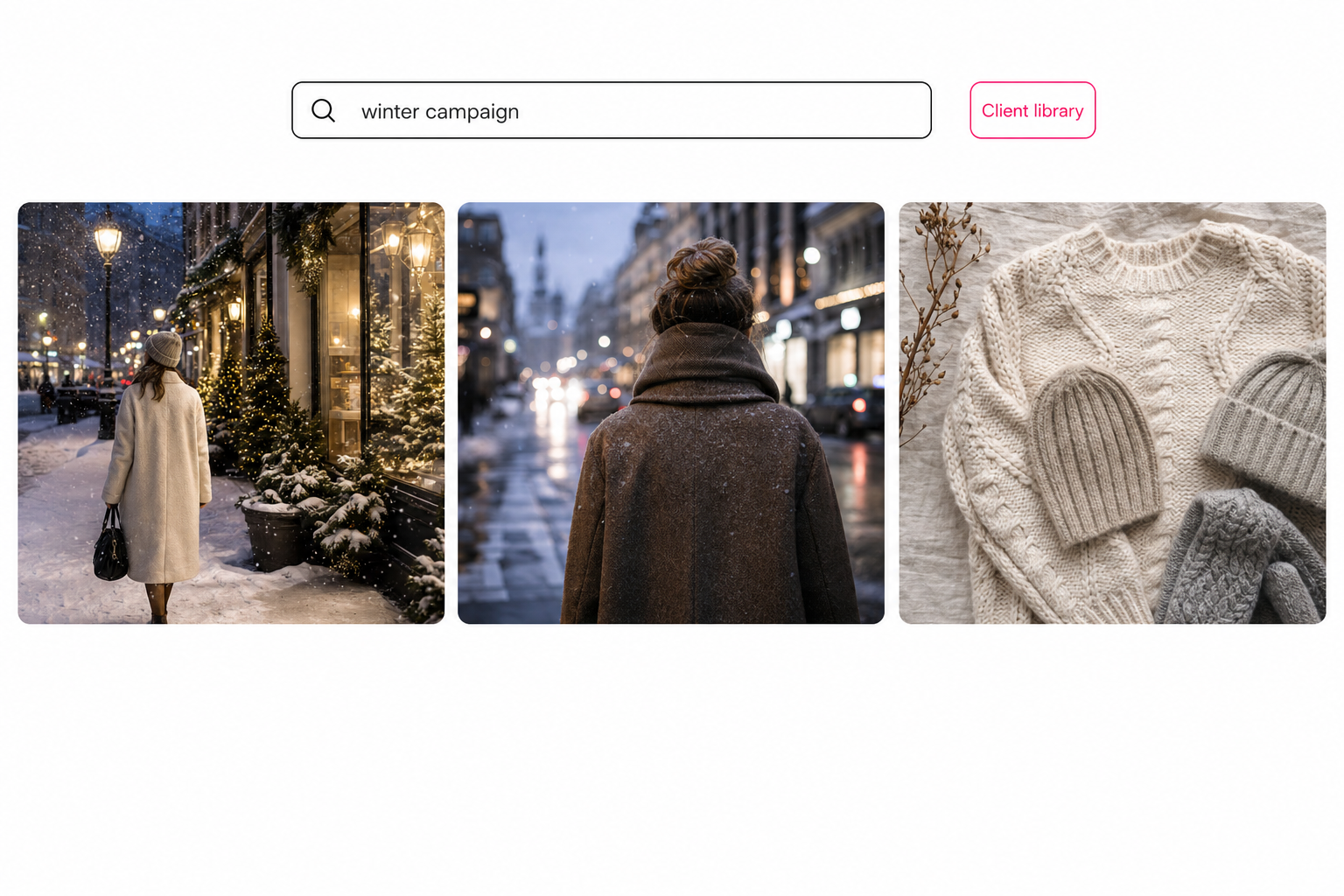
Tip. If the library you need to send already lives in Drive or Dropbox, run the search-and-share flow on it before deciding anything. Tagrly's free tier tags the first 500 photos in any folder, no credit card, which is enough to see whether searchable access beats a file transfer for your client.
Which way to send a photo library to a client fits you
- The contract ended and the client owns the work. A clean dedicated folder plus Drive ownership transfer, a Dropbox folder ownership change, or a full download to their storage. Free, done once.
- The library is past a few hundred gigabytes. Ship a portable SSD with tracking, and share the hero selects by link the same day.
- The client keeps coming back for photos. View-only access to a dedicated folder for small libraries; a searchable catalog layer, Tagrly is one option, once the library is big enough that finding beats sending.
- You deliver shoot by shoot, not library by library. That is proofing-gallery territory, and the curated-selects workflow in sharing specific photos with clients is the better playbook.
Sending a photo library to a client comes down to one early decision, copy or access, and one discipline, building the handoff container deliberately instead of sharing what you already have. The free transfer routes cover the file-moving part well. What they cannot transfer is findability, so bake it in with an index, real names, and tags, or hand over search itself and test that on 100 of your own photos first. For the wider job of taming the library before it ever gets sent, see our guide to finding any photo in your library.
Frequently asked questions
How do I send an entire photo library to a client?
Build a clean handoff folder first, then pick the transfer that matches the relationship. Copy everything the client is owed into a brand-new folder in Google Drive or Dropbox, so your working folders and other clients' work never enter the share. For a one-time handoff, give the client access to download or copy it to their own storage, or transfer ownership of the folder outright. For an ongoing relationship, share the folder as view-only or put a searchable gallery on top of it instead. Libraries past a few hundred gigabytes often move faster on a shipped external drive than over the internet. Whatever route you take, never send a link to the folder you actually work in.
Should I give the client a copy of the photo library or shared access?
It depends on whether the relationship is ending. A copy is right when the contract closes and the client owns the work: they get the files on their own storage, they carry the responsibility, and you can archive your side. The cost is a fork, because any edit made after the handoff exists in only one of the two libraries. Shared access is right when the client keeps coming back for photos: there is one current version, you can revoke the link later, and additions show up without another delivery. The cost is that you host the library and its organization stays your job. Many teams do both, one ownership handoff for the contracted deliverables plus standing view access to the active library.
How do I transfer ownership of a Google Drive folder of photos?
Share the folder with the client's Google account first, then use Drive's ownership transfer to make them the owner, following Google's own steps. Two catches are worth knowing before you promise it in an email. Ownership transfers are restricted across Google Workspace domain boundaries, so an agency account often cannot make an outside client the owner directly; the common workaround is giving the client access and having them copy or download everything into their own Drive. And once ownership moves, the storage counts against the client's quota and the control is theirs, so make sure the folder holds exactly what you intend to hand over and nothing else.
What if the photo library is too big to upload or download?
Ship it. A 38,000-photo library at typical file sizes is roughly 300 GB, which is around a day and a half of continuous uploading on a 20 Mbps connection, and cloud providers zip large downloads into multiple parts that confuse clients reliably. Somewhere past a few hundred gigabytes, copying the library to a portable SSD and shipping it with tracking is usually faster and produces fewer support emails than any link. Keep the cloud in the picture for the small stuff: send the couple hundred hero selects as a normal shared folder so the client has something usable the same day, and let the drive carry the full archive.
How will the client find anything in the library after the handoff?
Not with the files alone. A handoff transfers bytes, and findability lives in names, structure, and tags, which most libraries never had. The receiving team inherits tens of thousands of files named by camera counter and organized by your logic, not theirs, and nobody on their side has the memory of the shoots. The fixes that survive a handoff: a short index document listing what lives where, consistent file naming, and content tags. AI tagging tools can generate those tags in bulk on either side of the transfer, reading each photo and writing searchable descriptions of what it shows, which is far cheaper than the 5 to 8 hours per 1,000 photos that manual keywording takes.
Try Tagrly on your own photo library
Connect your Google Drive or Dropbox folder and Tagrly will tag every photo in bulk. Search by what is actually in the image, share specific shots with clients, and never lose a photo again.
- Free for your first 500 photos
- Read-only access, revoke anytime
- No credit card