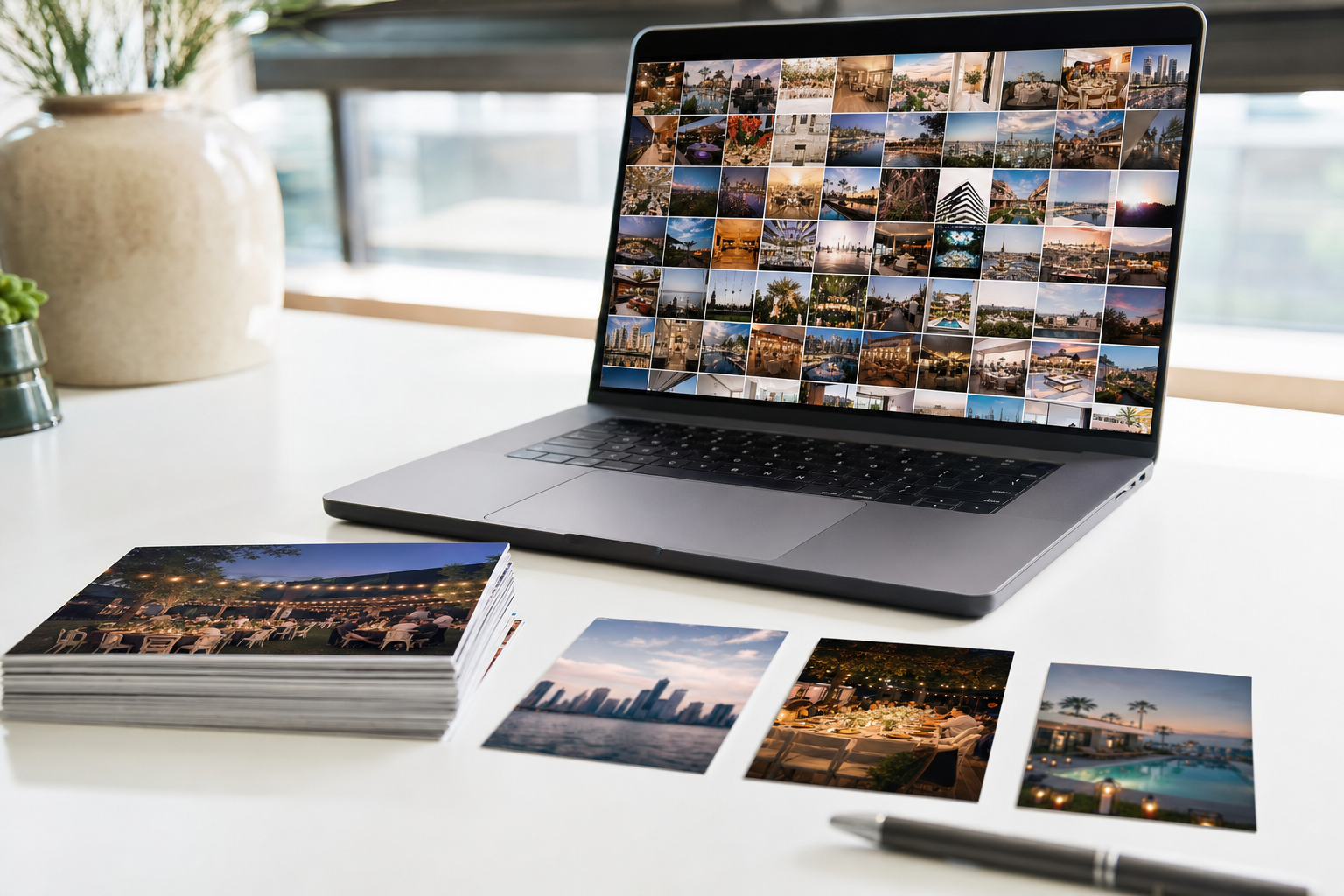
The launch shoot wrapped on Friday. 2,300 frames sit in a Google Drive folder called 2026-04-brand-shoot, the client wants the 25 approved images today, and the same folder holds the outtakes, two unapproved edits, and another client's campaign one subfolder over.
What sharing from Google Drive actually does
Google Drive shares files and folders through links, with three roles: Viewer, Commenter, and Editor. A folder link grants its role to everything inside the folder, including files you add later. That single fact drives every rule in this guide.
Access comes in two modes. "Restricted" shares with specific email addresses, and those people sign in with a Google account to open the link. "Anyone with the link" opens for whoever holds the URL, no account needed, which is why it is the usual choice for client delivery. Google's file sharing documentation covers the click-by-click mechanics.
The trap is granularity. Drive has no concept of "these 25 photos out of this folder of 2,300". You share a file or you share a container, so clean delivery means building a container that holds only what the client should see. For the same principle applied across every tool, not just Drive, see how to share specific photos with clients.
How to share client photos from Google Drive, step by step
The whole method takes about five minutes:
- Cull first. Pick the approved finals before you touch any sharing setting. The share should hold the client's photos, not your contact sheet.
- Create a fresh delivery folder outside your working folders, named for the client and the job, something like
Acme spring launch, finals. - Copy, don't move. Duplicating the finals into the delivery folder keeps your working structure intact and keeps the shared container disposable.
- Share the delivery folder with "Anyone with the link" as Viewer. Viewer is enough; Editor lets a stray click delete a final.
- Block downloads if these are proofs. In the share dialog's settings, untick the option that lets viewers download, print, and copy. Leave it on for paid finals.
- Unshare when the job closes. Google's page on stopping or limiting sharing shows where the switch lives. A calendar reminder works better than memory.
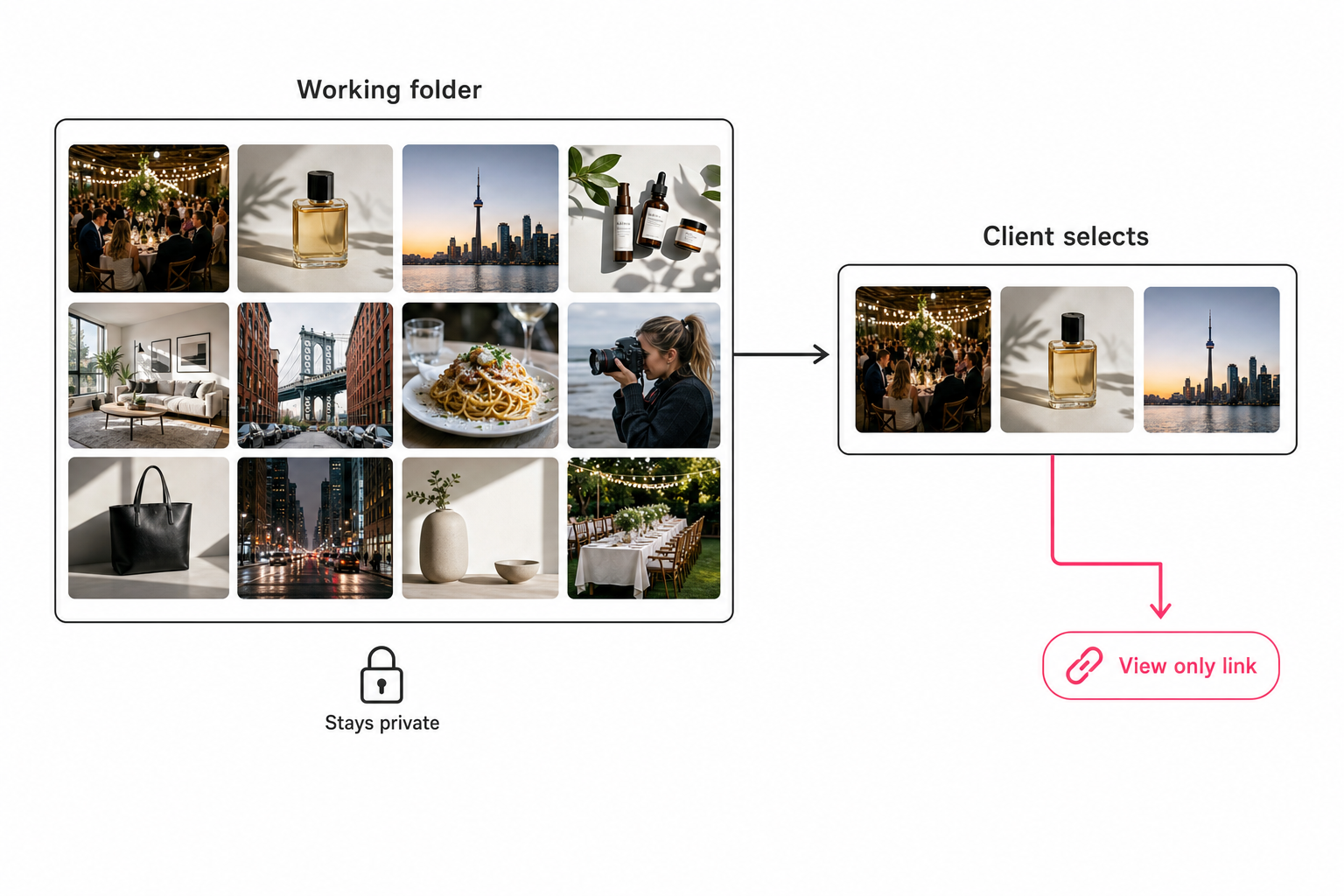
Warning. Never share the working folder or any parent folder. A folder link covers everything inside it for as long as it lives, so the reject frames you file there next month are exposed the moment you save them.
Where Google Drive falls short for client photo delivery
Drive moves the files. It does not present them, protect them over time, or help you find them. Five gaps show up in real client work:
- No gallery presentation. The client lands in a file manager: filenames, a plain thumbnail grid, your folder structure. No cover image, no branding, no highlight ordering.
- No proofing tools. There is no favorites button and no per-photo approval flow. The Commenter role lets a client leave notes on individual files, which works for a dozen photos and collapses past that.
- Links never expire on their own. Access expiration exists, but as of writing in August 2026 it is a paid Google Workspace feature aimed at access granted to specific people. On a personal account, the link you sent in March is still open in December.
- The folder stays live. Anything added to a shared delivery folder later is instantly visible. Convenient for a retainer client, a hazard for everyone else.
- Bulk downloads get clunky. Drive zips folder downloads, and large deliveries split into several zip files, which reliably produces a confused client email.
There is a sixth gap that hits before delivery even starts: finding the 25 approved shots. Drive's search reads filenames and a shallow set of auto-labels, and we measured how much Drive search misses in a separate post.
Adding a gallery layer on top of Google Drive
The free upgrade is a Google Photos album. Upload copies of the finals to Google Photos and send a shared album link: the client gets a clean scrolling gallery with comments instead of a file listing. The cost is a second copy in a second service, since Photos and Drive stopped syncing in 2019. Fine for occasional deliveries, tedious as a weekly routine.
Photographers delivering shoot by shoot usually land on a proofing gallery: Pixieset, Pic-Time, ShootProof, or CloudSpot. Branded pages, client favorites, watermarked proofs, download PINs, and expiring links are the daily-use features. Pricing and limits vary by vendor and change often, so check their current pages.
For marketing teams and agencies, the problem changes shape. Once a library passes the 1,000-photo wall, the expensive step is finding the shots, not sending them.
Image catalogs that connect to Drive read every photo, tag it by what it shows, with the focal subject ranked first so "rooftop at dusk" surfaces shots of rooftops rather than every frame containing sky, and turn any search result into a shareable collection link. Tagrly is one example, alongside tools like Pics.io, and the connection is read-only, so originals never leave Drive.
A typical partner request is 20 to 40 photos. Sharing a whole folder would expose thousands more. A search plus a collection link exposes exactly the picked shots and takes about a minute.
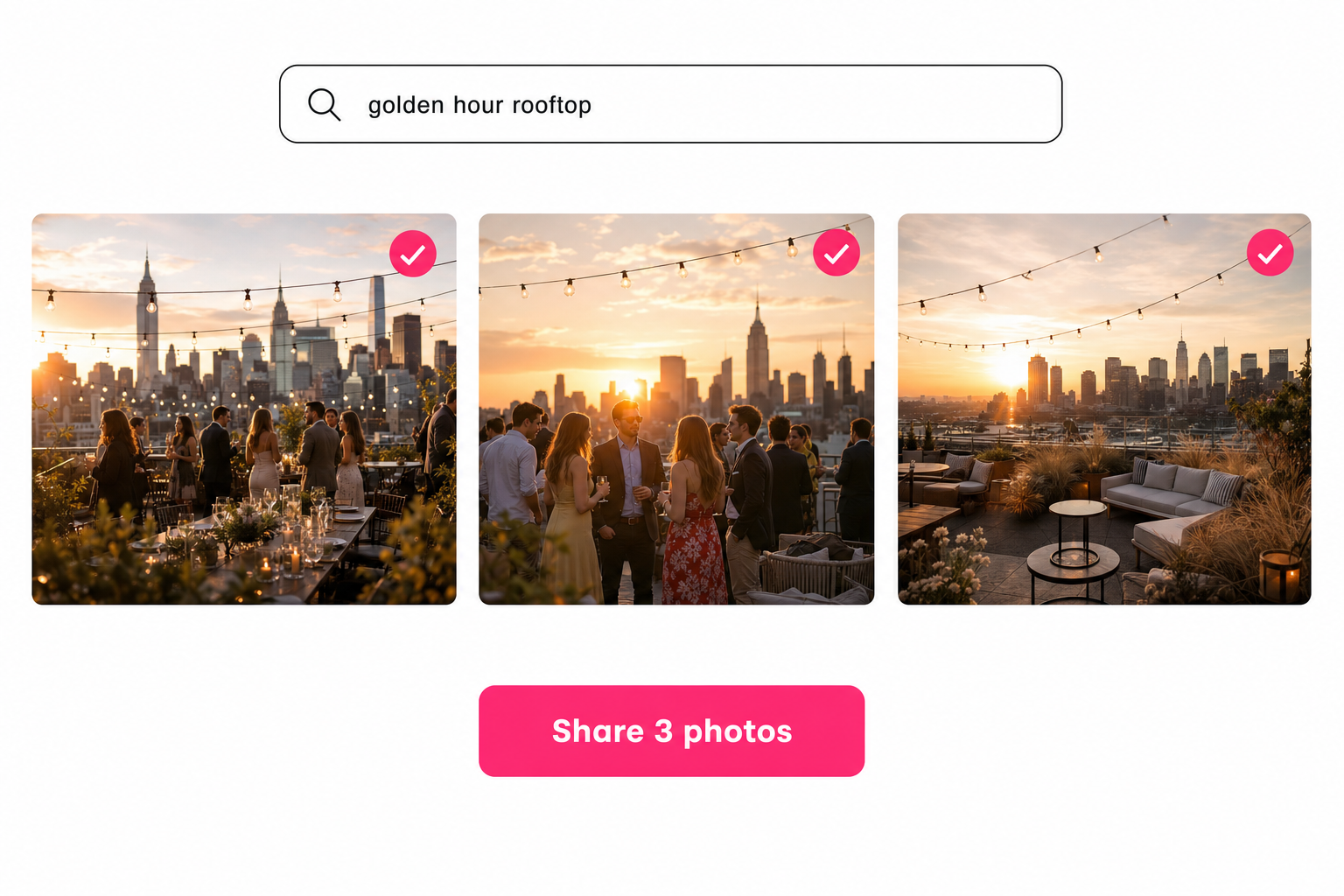
Tip. If your finals already live in Drive, test the search-and-share flow on your own photos. Tagrly's free tier tags the first 500 photos in any folder, no credit card, so you can build a collection and send yourself the link before a client ever sees one.
Which way to share photos with clients from Drive fits you
- A few finals, now and then. The delivery-folder method above. Free and genuinely enough.
- Shoot-by-shoot client photography. A proofing gallery like Pixieset, Pic-Time, or ShootProof. Favorites and watermarked proofs are worth paying for.
- A marketing team or agency with a big mixed Drive. A catalog with searchable collection links, Tagrly is one option, so delivery starts from a search instead of from copying files.
- Brand governance and a procurement process. An enterprise photo platform with approval flows. Below roughly 25 people it is usually overkill.
Sharing photos with clients from Google Drive is safe and free once you flip one habit: share a purpose-built selection, never a working container. The delivery-folder method covers most people most of the time. When deliveries become weekly, or when the slow part is finding the shots at all, add a gallery or catalog layer, and judge the catalog route by running it on 100 of your own photos. For the bigger job of taming the library itself, see our guide to finding any photo in your library.
Frequently asked questions
Can I share photos with a client from Google Drive without sharing the whole folder?
Yes, but you have to build the boundary yourself. Google Drive has no way to share 25 photos out of a folder of 2,300; you share a file or you share a container. The clean method is to create a brand-new delivery folder, copy only the approved photos into it, and share that folder with Anyone with the link set to Viewer. Your working folder never gets a link, so raw frames, rejected edits, and other clients' work stay private. For two or three photos, sharing the individual files works too. If you deliver selects from a large library every week, a catalog tool that turns a search result into a single shareable collection link removes the copy-and-prune step entirely.
Do Google Drive share links expire?
Not on their own. A Drive link stays live until you change the sharing settings, which means a gallery you sent in March is still open to anyone holding the URL a year later. Expiration dates on shared access exist, but as of writing in August 2026 they are a paid Google Workspace feature and apply to access granted to specific people, not to open anyone-with-the-link URLs. On a personal account the practical habit is a calendar reminder to unshare the delivery folder when the project closes. Proofing galleries and image catalogs treat link expiry as a standard checkbox, which is one of the main reasons frequent senders outgrow plain Drive links.
Can I stop clients from downloading my photos in Google Drive?
Partly. Drive's sharing settings include an option that removes the download, print, and copy actions for viewers and commenters, which is useful when you are sharing proofs the client has not paid for yet. It blocks the obvious save paths, not screenshots, so treat it as a speed bump rather than protection. Drive also has no watermarking, no download PIN, and no per-photo download limits. If watermarked proofing with controlled final delivery is the workflow you actually need, that is the core feature set of dedicated proofing galleries like Pixieset or ShootProof, and it is worth paying for rather than improvising in Drive.
Do clients need a Google account to view photos shared from Drive?
Not if you share with Anyone with the link. That mode opens for whoever holds the URL, signed in or not, which is why it is the default choice for client delivery. The alternative, Restricted sharing to specific email addresses, requires each recipient to sign in with a matching Google account, which is more secure but regularly produces access-request emails when a client opens the link from a personal address. The tradeoff to remember with anyone-with-the-link: the URL is the only credential, so anyone the client forwards it to can also open it. Keep the delivery folder small and unshare it when the job is done.
Is Google Drive good enough for delivering photos to clients?
For a handful of finals a few times a year, yes, and it is free. The delivery-folder method gives the client a working link in about five minutes with nothing new to sign up for. Drive falls short when you need presentation and branding, client favorites or proofing, links that expire on their own, or repeated deliveries selected out of a large mixed library. At that point the honest answer is a layer on top: a Google Photos album for a friendlier free gallery, a proofing tool for shoot-by-shoot client photography, or an image catalog with searchable collection links for teams sharing from tens of thousands of photos.
Try Tagrly on your own photo library
Connect your Google Drive or Dropbox folder and Tagrly will tag every photo in bulk. Search by what is actually in the image, share specific shots with clients, and never lose a photo again.
- Free for your first 500 photos
- Read-only access, revoke anytime
- No credit card