
Your work laptop is a Windows PC, your files sync to OneDrive, and Microsoft now puts Copilot one click away in nearly every app you open. The client shoots sit in a folder full of IMG_4827.jpg files. So can Copilot organize your photos, or does the AI stop where your library begins?
First, which Copilot are we talking about?
Copilot is one brand name stretched across at least three products that do very different things with photos, and search results for this question mix them freely. Sorting them out is most of the answer.
Consumer Copilot in OneDrive and Windows. The chat assistant you get with a personal Microsoft account or a free download. It answers questions about files and helps you write, but it is not a file organizer.
The Windows Photos app on a Copilot+ PC. A feature inside the Photos app on newer hardware that uses on-device AI to sort images into a small set of categories. This is the only one that touches your photo library automatically, and its reach is narrow.
Microsoft 365 Copilot in a business tenant. The enterprise version wired into SharePoint, Teams, and the Office apps, with its own image-tagging path. This one can genuinely tag pictures, but only ones that live in SharePoint.
The rest of this post looks at what each of these can and cannot do for a real photo collection, because that is where the hope and the reality split.
What Copilot can actually do with your photos
Copilot is useful with images. It is just useful one image, or one narrow job, at a time.
It describes and answers questions about a single photo. Upload an image to Copilot chat and it will tell you what the shot shows, pull text out of it, or draft a caption. Microsoft's Copilot in OneDrive page covers the file-question workflow. For a few photos this is a real free assist.
The Photos app sorts utility images on Copilot+ PCs. Microsoft's Auto-Categorization feature uses on-device AI to file images into four categories: Screenshots, Receipts, Identity documents, and Notes. They show up under a Categories entry in the sidebar, and the classification runs on the machine's dedicated AI chip, which is why it needs Copilot+ hardware. It is a tidy way to clear document clutter out of a camera roll.
Business Copilot can tag images in SharePoint. In a Microsoft 365 tenant, SharePoint's Image Tagger can generate descriptive keywords for pictures so they turn up in Microsoft 365 Copilot search. This is the one path where Copilot writes something searchable to a photo, and it is set up by IT for files already stored in SharePoint.
That list is real capability, not marketing. It is also where the good news ends for anyone holding a photo library rather than a camera roll or a SharePoint site.
Where Copilot stops on a working photo library
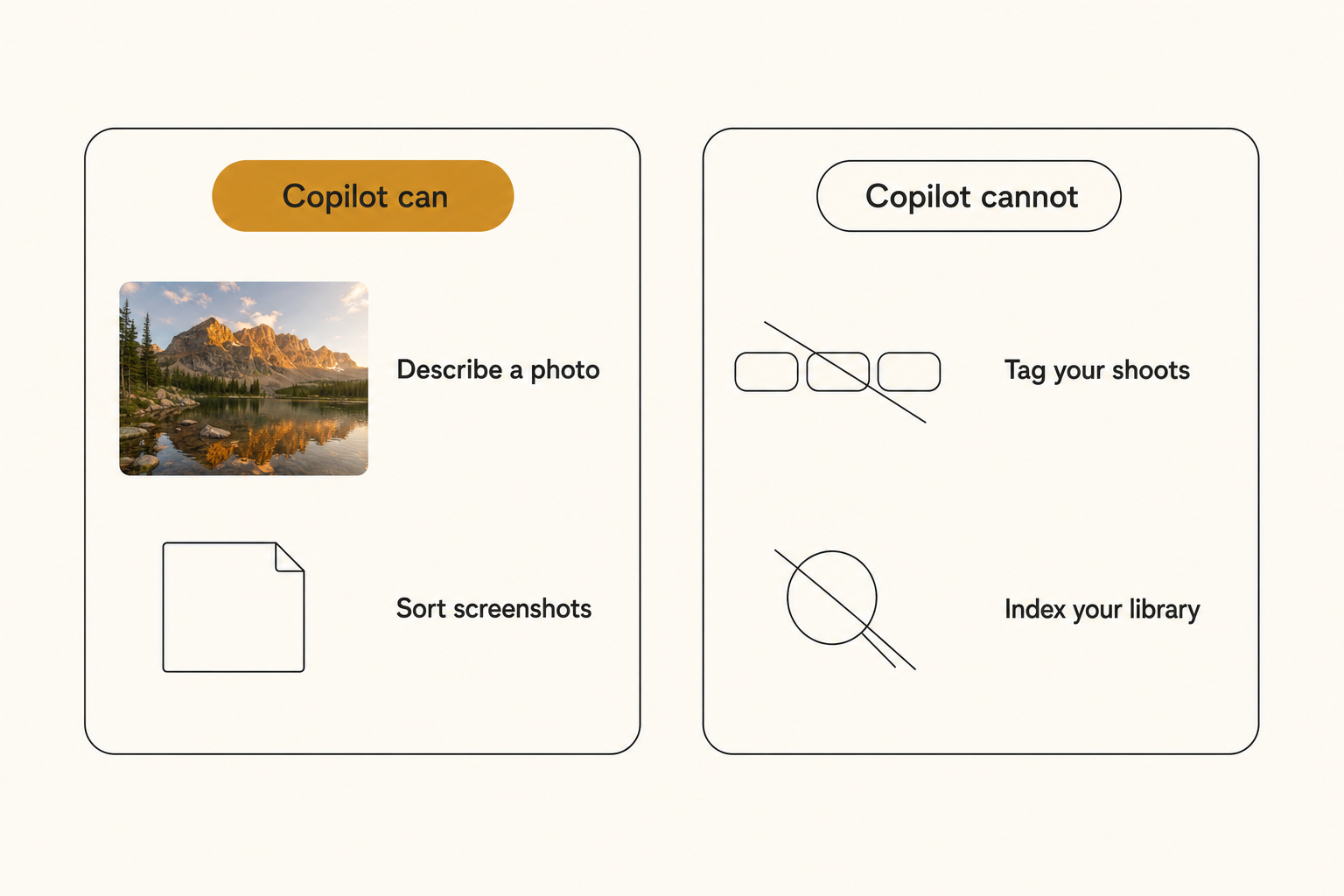
Consumer Copilot writes nothing down. Ask it about a photo and the answer arrives as chat text. No tag, keyword, or description is attached to the file, so the work evaporates when the window closes. It also does not move files into folders, rename them by content, or enforce any structure, and it often cannot see past the recent files on the OneDrive home page.
The four categories are the wrong four. Auto-Categorization files screenshots, receipts, IDs, and notes. A wedding archive, a product catalog, or a set of listing photos fits none of them. The feature is built to clear document scans out of the way, not to make your actual shoots findable, and it needs a Copilot+ PC most people do not have yet.
SharePoint tagging cannot reach your storage. The one path that writes real keywords only reads photos inside SharePoint. It does not connect to a personal OneDrive folder, a shared Google Drive, or a Dropbox account, which is where most creative teams keep their client work. If the photos are not already in SharePoint, this feature never sees them.
A tidier folder is not findability. Even where Copilot suggests file moves, a folder holds one dimension. File by client and the sunset shots vanish, file by year and the client's work scatters. Nobody remembers photos by folder. They remember what was in the frame.
Note. Copilot's data handling changes by product and plan, and a managed business tenant follows very different rules than a free consumer account. The five-check connection test in our guide to whether AI photo tagging is safe applies to assistants as much as to tagging tools, especially before you point anything at client work.
Folders and buckets sort photos. An index finds them.
The gap shows up on the first real request: "the terrace sunset shot from the spring launch, the one with the amber umbrellas." A folder tree answers that with twenty minutes of scrolling. A four-bucket categorizer does not answer it at all. An index answers in seconds, because every photo was described once, up front, and the descriptions are searchable.
Building that index by hand is the 1,000-photo wall: a skilled keyworder covers 100 to 200 photos per hour, which is 5 to 8 hours per 1,000, and most libraries grow faster than anyone types. Asking Copilot about photos one upload at a time does not change that math, because a person still sits in every round trip. It is the same ceiling every chat assistant hits, which is why ChatGPT cannot organize a real library either.
Connected AI catalogs remove the person from the loop. They read a Drive or Dropbox folder with read-only access, run every photo through a vision model, and write a focal-subject label, tags, and a one-sentence description to a shared searchable index. If you want the plain-English version of that pipeline, our explainer on how AI photo tagging works walks through each step.
Focal-subject tagging is the part that makes the search precise: the dominant element of each photo is identified first and ranked above the background context, so "amber umbrellas" returns the terrace shot, not every photo with an umbrella somewhere in it.
That full indexing pass ran unattended in the background.
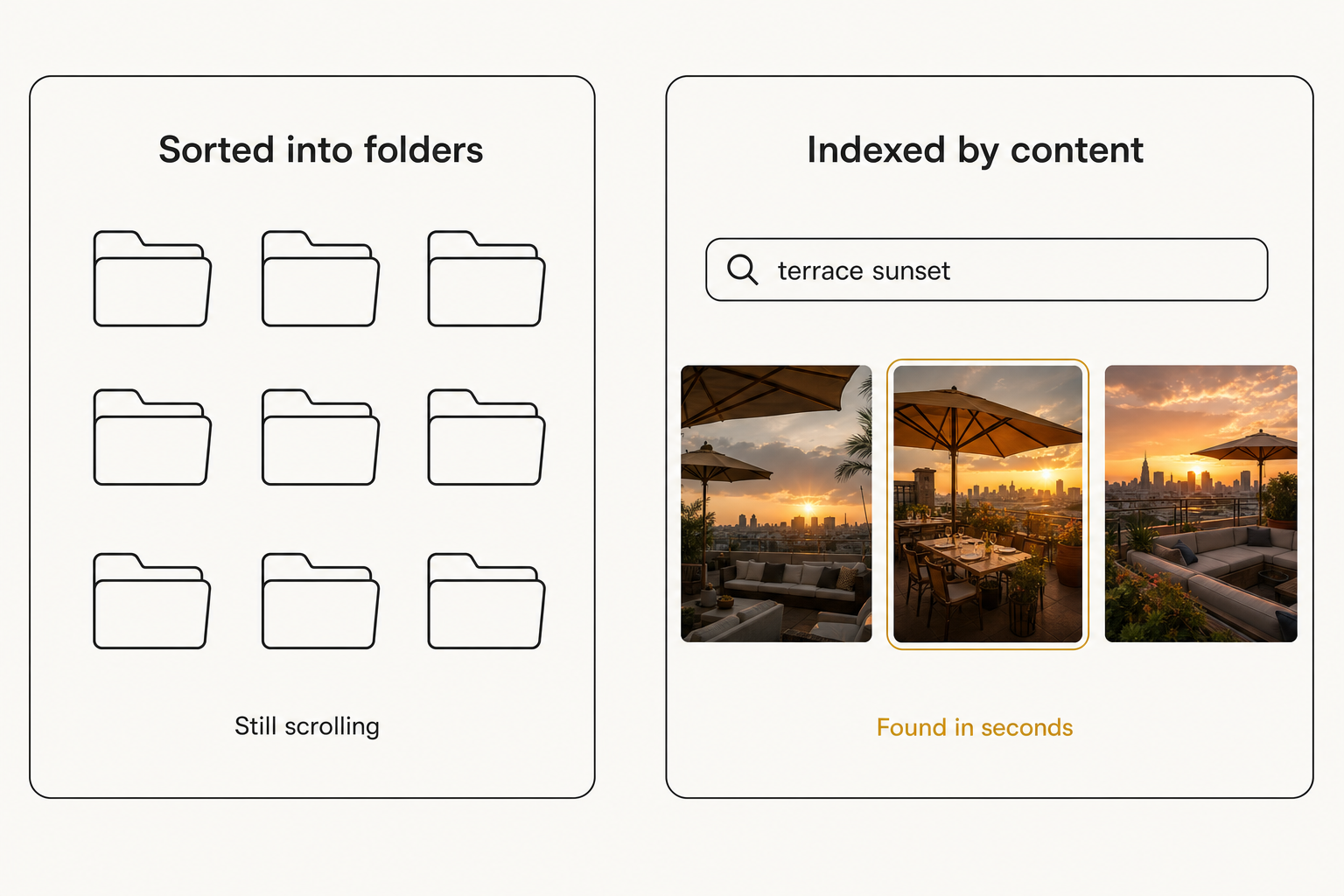
Tip. Tagrly is one catalog in that category, and its free tier tags the first 500 photos in any Drive or Dropbox folder, no credit card. Point it at your messiest folder and search for a shot nobody ever named.
Which tool fits your photo library
- Use consumer Copilot for one-off image questions: describe a photo, draft a caption, pull text out of a screenshot. Treat it as a helper, not an organizer.
- Turn on Auto-Categorization if you have a Copilot+ PC and your clutter is screenshots and receipts. It clears the utility pile and leaves your shoots alone.
- Use SharePoint Image Tagging if your team already runs on Microsoft 365 and the photos live in SharePoint. It is the one Copilot path that writes searchable keywords, so lean on your admin to enable it.
- Pick a desktop AI organizer like Excire Foto if you work solo and the archive must stay on your own machine. If you are on Windows and want the built-in options first, our guide to tagging photos in Windows covers them.
- Pick a connected AI catalog (Tagrly is one option) if the photos live in Drive or Dropbox and more than one person needs to find things in them.
So, can Copilot organize your photos? For a single image or a pile of screenshots, better than it could a year ago. For a working archive of client shoots in Drive or Dropbox, it stops at chat answers, four utility buckets, and a tagging feature locked inside SharePoint: nothing written to your files, no index built, nothing a team can search where the photos actually live.
Past a thousand photos, that gap is the entire job. If you want to feel the difference on your own shots, run a free scan on a real folder and search it by what the photos show.
Frequently asked questions
Can Copilot in OneDrive organize my photos?
Not the way you are picturing. Copilot in OneDrive can answer questions about supported files, summarize them, and compare them, but it does not move photos into folders, rename them by content, or batch-sort a library. Microsoft's own support pages frame it as a chat assistant for documents, not a file organizer, and it often cannot even see the full folder structure of your My Files tab. A February 2026 update lets Copilot agents act on files inside automated workflows, but practical photo organization is still a gap. For a handful of images that is a useful free assist. For a library of thousands, nothing is written to the photos and nothing becomes searchable afterward, so the work does not carry.
Does the Windows Photos app auto-categorize my photos with AI?
Yes, but only into four utility buckets and only on Copilot+ PCs. The Auto-Categorization feature in the Windows 11 Photos app uses on-device AI to sort images into Screenshots, Receipts, Identity documents, and Notes, which appear under a Categories entry in the sidebar. It runs on the Neural Processing Unit those PCs ship with, which is why it needs Copilot+ hardware. It is genuinely handy for clearing document clutter out of a camera roll. It does nothing for wedding, product, event, or listing photos, because none of those fit the four categories, and it does not describe a scene or write reusable tags you can search by later.
Can Microsoft Copilot tag photos in SharePoint?
In a business Microsoft 365 tenant, yes, through a different feature than the consumer chat. SharePoint's Image Tagger and the organizational asset library can generate descriptive keywords for pictures so they are findable in SharePoint and Microsoft 365 Copilot search. This is real tagging, but it lives inside SharePoint and is set up by IT, not pointed at a personal OneDrive, a Google Drive, or a Dropbox account where most creative teams keep their shoots. If your photos already live in SharePoint and your admin has enabled it, it helps. If they live anywhere else, it does not reach them.
What is the fastest way to make a large photo library searchable?
Index it once with a connected AI catalog. These tools read a Google Drive or Dropbox folder with read-only access, run every photo through a vision model, and write a focal-subject label, a set of tags, and a one-sentence description to a searchable index the whole team can use. That full pass ran unattended in the background. Tagrly is one example of the category, and its free tier covers the first 500 photos in any folder, so you can test the search on your own shots before paying anything.
Is Copilot safe to point at client photos?
It depends which Copilot and which plan. Consumer Copilot, business Microsoft 365 Copilot, and the on-device Photos features all handle data under different rules, and enterprise Copilot follows your tenant's compliance settings while the free consumer version does not. Before you connect any AI tool to client work, run it through a short checklist: read-only access, no copies made of the originals, no clause allowing your photos to train a model, tags stored rather than the full images, and a clean way to export and leave. Our guide to whether AI photo tagging is safe walks through that test in detail.
Try Tagrly on your own photo library
Connect your Google Drive or Dropbox folder and Tagrly will tag every photo in bulk. Search by what is actually in the image, share specific shots with clients, and never lose a photo again.
- Free for your first 500 photos
- Read-only access, revoke anytime
- No credit card