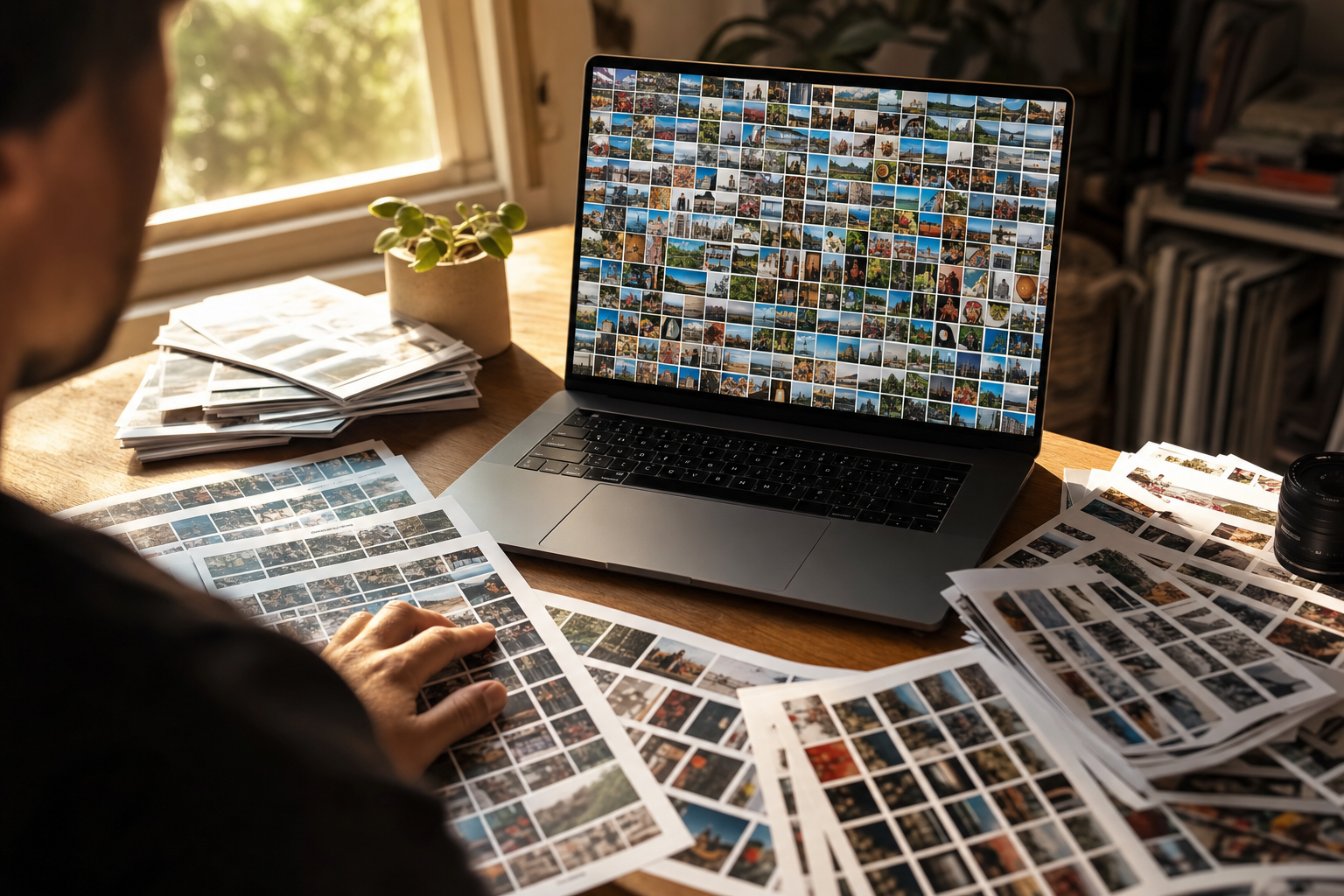
Search for the best AI photo tagging software and you get lists that count to fifteen without ever saying which tools tag a whole folder and which tag one upload at a time. Meanwhile you have 8,000 untagged photos in a shared drive and a deadline.
How we judged the best AI photo tagging software
Every tool on this list cleared at least three of five bars. The bars, in the order they usually matter:
- Real bulk. The tool scans a folder or a whole library, not one upload at a time. This is the 1,000-photo wall test: past a thousand photos, one-at-a-time tools stop being tools.
- Works where your photos live. Local disk, Lightroom, Drive, or Dropbox. A tool that demands a migration loses before it starts.
- Output you can use. Keywords you can export, search, or publish, not labels trapped inside an app.
- A price shape you can predict. Free, buy-once, per-photo, or subscription. Each is fine; surprises are not.
- Team access. Whether two people can search the same tagged library without passing a laptop around.
No tool clears all five. That is why this list is sorted by situation instead of ranked one to ten.
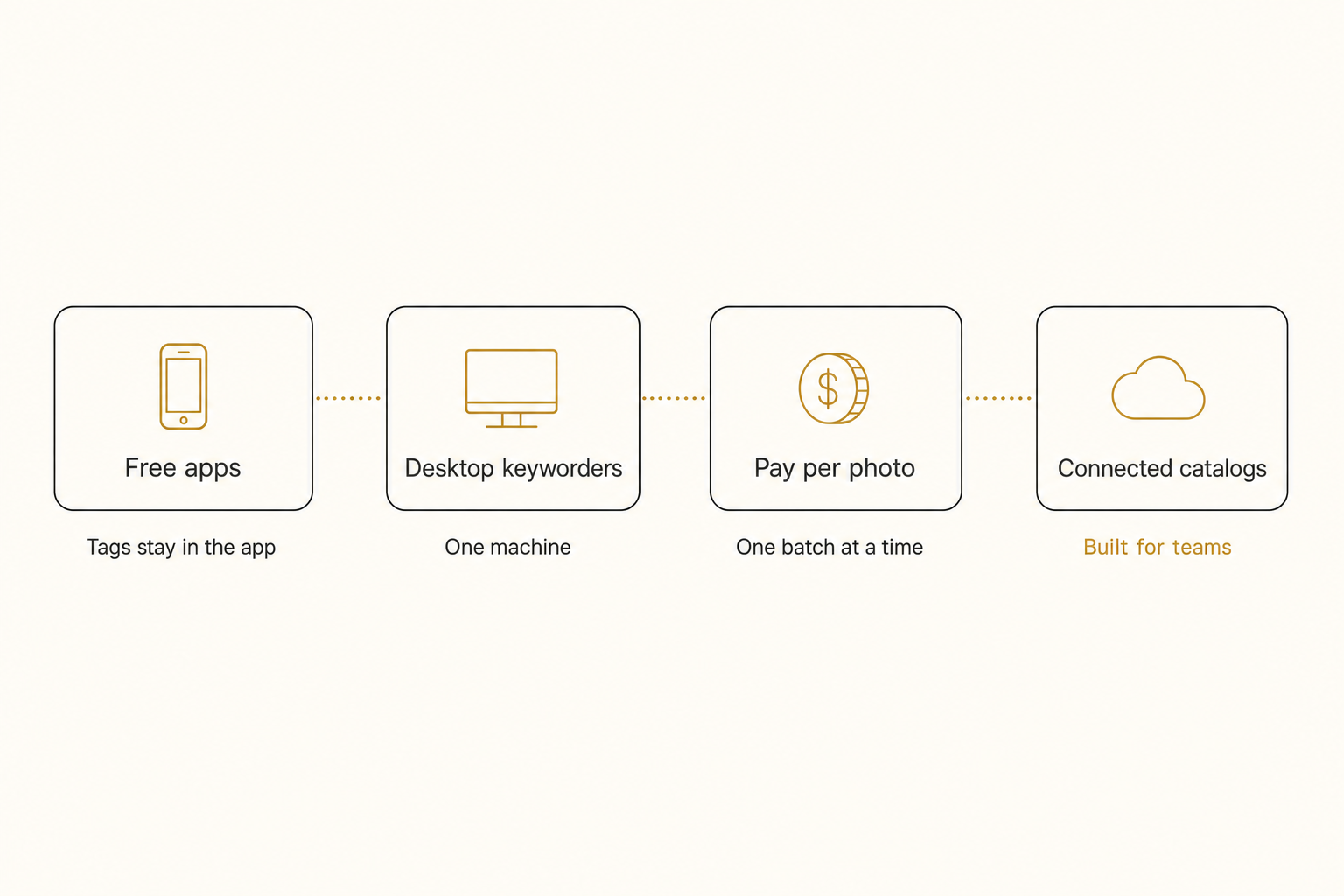
Best free AI photo tagging: Google Photos and digiKam
For a personal library, the best free AI photo tagging comes from Google Photos. For a solo photographer who wants to own the metadata, it is digiKam.
Google Photos
Google Photos auto-labels everything you upload at no charge. It recognizes objects, scenes, and faces, so "birthday cake" or "beach" just works, with zero typing. For family libraries and phone camera rolls it is genuinely hard to beat.
The ceiling is ownership. The tags never leave the app: no export, no bulk download, no way to run the same labeling on a Drive folder you have not uploaded into Photos. Free storage also caps at 15 GB, which a working photographer passes in weeks.
digiKam
digiKam is free, open-source, and writes real keywords into standard metadata fields you own forever. Recent versions add local AI auto-tagging that runs on your own machine at no per-photo cost.
The ceiling is effort and reach. Setup takes an afternoon, the AI is lighter than a top-tier vision model, and the catalog lives on one computer. Our free AI photo tagging guide covers where each free route runs out.
Best buy-once desktop keyworders: Excire Foto and ON1
For solo photographers with a local archive, the best AI photo tagging software is a buy-once desktop keyworder. Two lead the category.
Excire Foto
Excire Foto runs its AI entirely on your machine, tags tens of thousands of local photos in a sitting, and reviewers consistently rate its natural-language search as the best in the desktop tier. It is a one-time license rather than a subscription; check their site for current pricing.
ON1 Photo Keyword AI
ON1 Photo Keyword AI is the pick if you live in Lightroom. It generates keywords, writes them to standard fields, and slots into an existing Lightroom Classic workflow instead of replacing it.
Both share the same ceiling: they are single-machine tools. The searchable catalog stays on one computer, so the moment a teammate needs to run the same search, the category runs out. We compare output quality across these tools head-to-head in our photo metadata generators comparison.
Best pay-per-photo tagging: PhotoTag.ai and the DIY vision APIs
For stock photographers who keyword uploads a batch at a time, the best fit is a pay-per-photo web tagger, and PhotoTag.ai is the strongest one. Upload a batch, get back keywords, titles, and descriptions shaped for stock platforms, and pay per image processed.
The ceiling is the workflow itself. Upload-based tools do not watch a folder, do not build a shared searchable catalog, and per-photo pricing compounds fast on a 20,000-photo archive. They are built for the outbound stock pipeline, not for finding your own photos later.
Developers have a fourth option: calling a vision model directly. Anthropic's vision documentation shows what modern models return for an image. This route is infrastructure rather than product: you get raw tags per photo and build the ingest, database, and search yourself.
Best AI photo tagging software for teams: connected catalogs
If your photos live in Google Drive or Dropbox and more than one person searches them, a connected catalog is the only category built for the job. These tools connect over a read-only link, tag the whole library in bulk without downloading it, and store results in a searchable index the whole team shares.
Tagrly is the example we know best, and we will state the numbers rather than the adjectives. The first full scan ran unattended in the background, and what was already read was searchable while the rest was still going. Search on the resulting catalog ranks by focal-subject tagging, so "magnolia tree" surfaces photos of a magnolia tree instead of every photo that contains one.
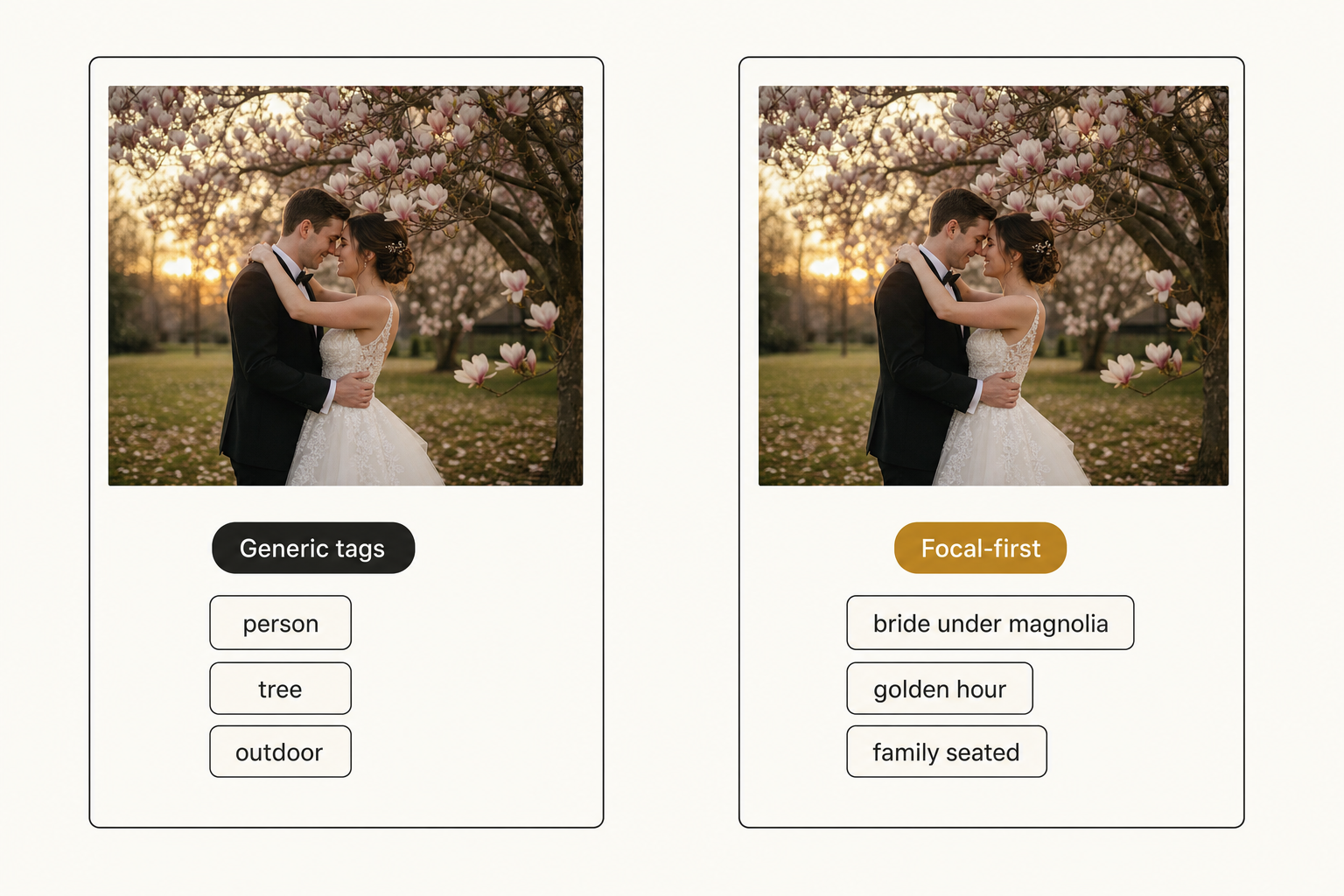
Output quality is where connected catalogs split from cheaper tiers. Generic taggers return flat lists like "person, tree, outdoor." Tools built for publishing return publishable sentences; you can judge the gap yourself on your own photos, since every Tagrly plan, the free tier included, runs the same full analysis.
At the heavyweight end of this category sit enterprise brand libraries like Brandfolder and Bynder. They do bulk tagging well, but they expect you to migrate photos into their storage and they are priced for procurement departments, not five-person studios.
Tip. Tagrly's free tier tags the first 500 photos in any Drive or Dropbox folder, no credit card. Run it on a real folder and compare the output against whatever free tool you are using now. Twenty minutes of side-by-side beats any list, including this one.
Which AI photo tagging software should you pick?
Pick by your situation, not by a ranking:
- Pick Google Photos if the library is personal, you search it inside the app, and you never need to export a tag.
- Pick digiKam if you are solo, want to own your metadata forever, and do not mind a one-machine setup.
- Pick Excire Foto or ON1 Photo Keyword AI if you work from a local archive or live in Lightroom and prefer a buy-once license.
- Pick PhotoTag.ai if you keyword stock submissions a batch at a time.
- Pick Tagrly if your photos are in Drive or Dropbox and a team needs to search and share the same library.
- Pick Brandfolder or Bynder if you have 100+ users and a procurement department.
The best AI photo tagging software is the one that meets your photos where they already are and hands the results to everyone who needs them. For most solo photographers that is a desktop keyworder. For most teams with a cloud drive full of photos, it is a connected catalog, and the free tiers mean testing that claim costs nothing but an afternoon.
Frequently asked questions
What is the best AI photo tagging software in 2026?
There is no single best tool, because the category splits into four kinds that solve different problems. Google Photos is the best free option for a personal library that lives inside the app. Excire Foto and ON1 Photo Keyword AI are the best buy-once desktop keyworders for solo photographers who work locally or in Lightroom. PhotoTag.ai is the best pay-per-photo web tagger for stock keywording. And a connected catalog like Tagrly is the best fit when the photos live in Google Drive or Dropbox and more than one person needs to search them. Pick by where your photos live and who searches them, not by a numbered ranking.
Is there good free AI photo tagging software?
Yes, with ceilings. Google Photos auto-labels everything you upload at no charge, so you can search 'beach' or 'dog' without typing a single keyword, but the tags never leave the app and free storage caps at 15 GB. digiKam is free, open-source, and writes real keywords you own into your files, but the AI is lighter than a paid vision model and everything lives on one machine. For a personal library under about a thousand photos, one of those two is usually all you need.
What is the best AI photo tagging software for Lightroom users?
Excire Foto and ON1 Photo Keyword AI are the two strongest choices for photographers who live in Lightroom or work from a local archive. Both are buy-once desktop licenses rather than subscriptions, both run the AI on your own machine, and both write standard keywords you keep even if you stop using the tool. The tradeoff is that they are single-machine tools: the searchable catalog they build does not extend to a teammate on another computer.
Can AI photo tagging software work without uploading my photos?
Yes, two of the four categories never require an upload. Desktop keyworders like Excire Foto and digiKam run entirely on your own machine against local files. Connected catalogs like Tagrly read photos where they already live, in Google Drive or Dropbox, over a read-only connection, generate the tags, and store the results in a searchable index. Your originals stay in place and nothing is moved or copied to a new home. The categories that do require uploads are the free consumer apps and the pay-per-photo web taggers.
How much does AI photo tagging software cost?
The price shape matters more than the sticker. Free consumer apps cost nothing but trap the tags. Desktop keyworders are buy-once licenses, typically a one-time purchase in the low hundreds; check each vendor's current page for exact numbers. Pay-per-photo web taggers look cheap per image and add up quickly on a large library. Connected catalogs are monthly subscriptions sized by library or team. Most paid tools, Tagrly included, offer a free tier or trial, so you can compare real output on your own photos before spending anything.
Try Tagrly on your own photo library
Connect your Google Drive or Dropbox folder and Tagrly will tag every photo in bulk. Search by what is actually in the image, share specific shots with clients, and never lose a photo again.
- Free for your first 500 photos
- Read-only access, revoke anytime
- No credit card